 ISSN: 1108-6963





Theodore Antoniou’s Kērēthres (Honeycombs, 2008) for Voice and Instrumental Ensemble: Ambiguous Voice Leading, “Narrative Rhythms,” and Suspended Harmony
Theodore Antoniou’s Kērēthres (Honeycombs, 2008) for Voice and Instrumental Ensemble: Ambiguous Voice Leading, “Narrative Rhythms,” and Suspended Harmony
Theodore Karathodoros
Ionian University
theodore.karathodoros@gmail.com
ABSTRACT: Kērēthres (Honeycombs, 2008), for baritone/narrator, alto and bass flute, piano, viola, cello, and tape, represents a characteristic instance of Theodore Antoniou’s late compositional thought, as vocal writing, poetic language, and melodic-harmonic organization converge to produce formal fluidity and a sense of harmonic suspension. The fragmentary selection of poetic material from Kostas Varnalis’s collection Kērēthres contributes to the formation of a distinctive temporal and narrative trajectory, in which language is articulated through selected excerpts, shifts in modes of vocal delivery, and successive musical sections. The present study investigates the parameters of musical organization that contribute to this conception of form. The analysis focuses on the organization of the pitch-rhythmic material, with particular emphasis on the structure and directionality of the vocal melodic lines, the principles of text setting, the transient emergence of tonal centers, and the processes through which expectations of tonal or pitch stability are deferred, displaced, or weakened. Particular attention is also given to the ways in which Antoniou’s “narrative rhythms” contribute to the temporal organization of vocal and verbal delivery. In this respect, Kērēthres reveals a distinctive relationship among melodic directionality, tonal centricity, pitch focalization, and harmonic instability. Voice, poetic language, and the instrumental ensemble are thus integrated into a continuous process of musical transformation, through which a sense of expectation and instability remains active and form gradually takes shape over the course of the work.
KEYWORDS: Theodore Antoniou, Kostas Varnalis, Kērēthres, voice leading, tonal centricity, narrative rhythms, harmonic suspension, octatonic collection, processual form, music and theater, Greek art music
1. Introduction
[1.1] Theodore Antoniou (1935–2018) remained consistently attuned to international currents in musical creation and engaged directly with the musical avant-garde of the twentieth century. This orientation is evident in his assimilation of contemporary idioms into his compositional output and is further contextualized by his personal contact with prominent figures such as Darius Milhaud, Leonard Bernstein, Aaron Copland, Ernst Krenek, George Crumb, and Lukas Foss (Τιμητική Βραδιά–Συναυλία 2015, 2).[1] Although his oeuvre exhibits considerable stylistic breadth, certain recurring compositional ideas and organizational principles nevertheless permeate his music and contribute decisively to the formation of his expressive language.
[1.2] A pivotal factor in the formation of Antoniou’s personal musical language was his experience in composing for the theater. Indeed, during the early stages of his creative development, he focused particularly on this category of works, which became a significant field of his professional activity as a composer. Antoniou himself repeatedly underscored the impact of the theater on his musical thought in numerous interviews and public lectures,[2] consistently affirming that his creative path was profoundly shaped by the knowledge and lived experience acquired through writing for the stage, as well as by his collaboration with the practitioners who constitute the theatrical world—directors, actors, lighting designers, and others.
[1.3] However, the influence of theater on Theodore Antoniou’s music should not be examined solely through the lens of the performers’ stage action or of particular modes of vocal delivery and articulation, such as spoken declamation, rhythmic recitation, whispering, fragments of speech, and Sprechgesang. The melodic-rhythmic material must also be taken into account. A comparison with Antoniou’s music for Euripides’ Bacchae, composed for the production presented at the Comédie-Française in April 1976 (Antoniou 1982),[3] reveals that the profile of the melodies in the choral sections closely resembles the vocal writing of Kērēthres (2008), the work under discussion, as well as that of other choral compositions, including Le Jardin des Rochers (2012), Eirēnē [Peace] (2014), Astron ēdē anatetalken [A Star Has Already Risen] (2014), and Kontakion of Christmas (2016/2017). In other words, the distinctive melodic character of his theatrical works also recurs in later compositions, including works dating from the final decade of his creative activity.[4] Moreover, Antoniou did not hesitate to describe music for the theater as one of the “correct” forms of musical expression, thereby calling into question the very notion of “absolute music”:
Personally, I believe that it is also one of the “correct” forms of music. I do not believe in so-called “absolute music” […]. I believe that every recipient, every human being, as well as every sender, every creator who writes music, carries with them an immense world—a world connected with their origins, their family, their interests, their education, and the era in which they live. Each person is, in other words, a theatrical figure, a dramatic figure, carrying all these origins with them; consequently, they could never express themselves through what is known as an “absolute” musical mode […]. (Antoniou 1987)[5]
[1.4] A second element discernible in Antoniou’s musical thinking, closely connected with the views outlined above, is his conception of “abstract program music.” Antoniou first introduced this idea in Dialogues (1962) for flute and guitar. At the core of this concept lies the conviction that the organizational principles shaping his compositions arise from conscious or unconscious processes of association, a view that also distances his thinking from the ideals of absolute music. In other words, Antoniou refers to abstract ideas and to fluid, largely intangible states—such as the expressive fluctuations that characterize a dialogue, the movement of sound through space, or the manner and techniques of playing an instrument—which stimulate his creative thought and which the music may render in sound, thereby contributing to the meaning of the work as it comes into being (Karathodoros 2015).
[1.5] As the composer explains in his programmatic commentary:
[Dialogues] is a sequence of nine short pieces where I introduced for the first time the idea of abstract program music. The concept of “program” is not used in the traditional sense of the romantic period. The “program” here correlates with an abstract extramusical idea that plays a dominant role in the organization of the musical material, being an additional parameter on the four already existing ones (pitch, duration, timbre, dynamics). (Antoniou 2014b)[6]
[1.6] The music of Theodore Antoniou has been examined in studies devoted to different areas of his oeuvre, illuminating various aspects of his compositional thought and musical language. In his doctoral study of Antoniou’s complete works for solo piano, Konstantinos Destounis (2019) adopts a performance-oriented approach, combining score-based investigation with his own experience as a pianist and his direct collaboration with the composer. Central to his research is Antoniou’s concept of “Abstract Programmatic Music,” which he examines in relation to extramusical associations, interpretive decisions, and the relationship between notation and sonic realization (Destounis 2019, 40–47, 165–66). Approaching Antoniou’s output from a different perspective, Sophia Samara (2016) provides a systematic investigation of his operatic and music-theatrical works, examining both their large-scale formal organization and particular aspects of harmonic, rhythmic, stylistic, and orchestral writing. Her analyses bring musical composition into relation with poetic and dramatic texts, stage action, and distinct forms of musical dramaturgy, offering a substantial framework for understanding the theatrical dimension of Antoniou’s creative work (Samara 2016, 3–6, 262–66).
[1.7] Scholarship has also focused on individual compositions and particular areas of his oeuvre. Athina Gratsouna (2020) investigates the cycle 24 Caprices for Violin Solo, combining formal analysis and the examination of pitch organization with a consideration of the violin’s technical and timbral possibilities. Particular attention is given to the coexistence of tonal references, chromaticism, modality, and atonality, as well as to the relationship between contemporary instrumental writing and Greek musical tradition (Gratsouna 2020, 13–16, 68–69). Rodopi Chardali (2012), within a broader investigation of Antoniou’s oeuvre and compositional style, undertakes a detailed analysis of the cantata Nenikēkamen (1971), examining its formal organization, orchestration, notation, and the relationship of its musical setting to the ancient Greek text and the work’s programmatic conception (Chardali 2012, 115–42). An earlier analytical study of the same composition had been undertaken by Minas Alexiadis (1986). A different perspective is offered by Michalis Andronikou and Friedemann Sallis (2012), who explore questions of local and cultural identity in contemporary Greek music, with specific attention to Antoniou. Through selected compositions, they investigate how rhythmic, melodic, and timbral characteristics of Greek traditional music are incorporated into his contemporary compositional idiom (Andronikou and Sallis 2012, 26–30).
[1.8] Against this scholarly background, the present article approaches Kērēthres through three interrelated analytical strands: ambiguous voice leading, “narrative rhythms,” and suspended harmony. Examining these parameters in conjunction sheds light on key aspects of Antoniou’s compositional thought: the horizontal organization and directionality of melodic lines; the role of rhythmic formations in relation to vocal delivery and the temporal articulation of poetic language; and the sense of harmonic hovering generated by the use of heterogeneous pitch collections, shifts between modal and chromatic fields, and the transient emergence of tonal centers.
2. Kērēthres (Honeycombs, 2008) for Voice and Instrumental Ensemble
Criteria for the Selection of the Work
[2.1] The selection of Kērēthres for the present study rests on a combination of historical, aesthetic, analytical, and research-related considerations. First, the work, composed in 2008, belongs to the final decade of Antoniou’s creative activity and offers a revealing example of the direction his music took during those years. Its vocal writing, the distinctive configuration of its melodic lines, the modal organization of its pitch material, and the temporary focalization of particular pitches together define a musical field in which Antoniou’s mature compositional idiom enters into dialogue with earlier aspects of his practice, particularly his music for the theater and his approaches to setting poetic language. This connection is evident even in the way Antoniou designates the vocal part: in the work’s program notes, he refers to it as “baritone/narrator,” whereas in the score he uses the designation Baritone-Actor (Antoniou 2009, 25; 2008, [1]).
[2.2] A further criterion informing the selection of Kērēthres is the presence of prerecorded material (tape) in the work’s closing region. The score indicates the entrance of the tape with the instruction “TAPE (fade in)” in the closing measures, without notating the prerecorded material itself. Although the tape is absent from the description of the work in Antoniou’s official work catalog, it is clearly audible at the end of the composition. Following works in which Antoniou had explicitly employed tape—such as East–West (1993), Zon B (1996), Paravasis III (2002), and Fiddle and Its Shadow (2003)—Kērēthres appears to represent a late instance of the use of prerecorded material in his oeuvre (Antoniou 2014a, 8, 12, 25). The recorded segment incorporates the sound of the glass harmonica—a timbre Antoniou had also employed in East–West—alongside processed recitations of Varnalis’s poetry by both the poet himself and Antoniou.[7] The tape thus endows the closing region with an additional vocal and timbral dimension, as live utterance gives way to prerecorded traces of speech, recitation, and sonic memory.
[2.3] Another significant consideration lies in the particular circumstances surrounding the composition and realization of Kērēthres. The work was written for performers who belonged to Antoniou’s close circle of collaborators and was associated with a specific artistic and recording project centered on the poetry of Kostas Varnalis. As the composer himself observed, “I chose my fellow musicians as performers for their talent and for their musical and technical qualities” (Antoniou 2009, 26).[8] This remark casts light on the work by situating it within the particular artistic context of its creation, in which the act of composition, the interpretive capacities of Antoniou’s collaborators, and the recording process are closely intertwined. In this sense, Kērēthres is examined both as an autonomous musical text and as the product of artistic relationships, performance conditions, and circumstances of production.
[2.4] Finally, the present author’s role as producer of the CD featuring works by Greek composers inspired by the poetry of Kostas Varnalis, together with his exchanges with Antoniou during the recording and mixing of the work, makes Kērēthres a particularly fruitful subject of inquiry.[9] This degree of personal proximity complements the analytical evidence by providing an additional interpretive framework and enabling the incorporation of insights derived from direct collaboration with the composer and from first-hand experience of the work’s sonic realization. Such first-hand observations are treated as complementary contextual evidence and are distinguished from analytical claims grounded directly in the score and recording. In this way, the analytical approach draws upon observations and interpretive perspectives that emerged from the relevant discussions with Antoniou and contribute to a fuller understanding of the work.
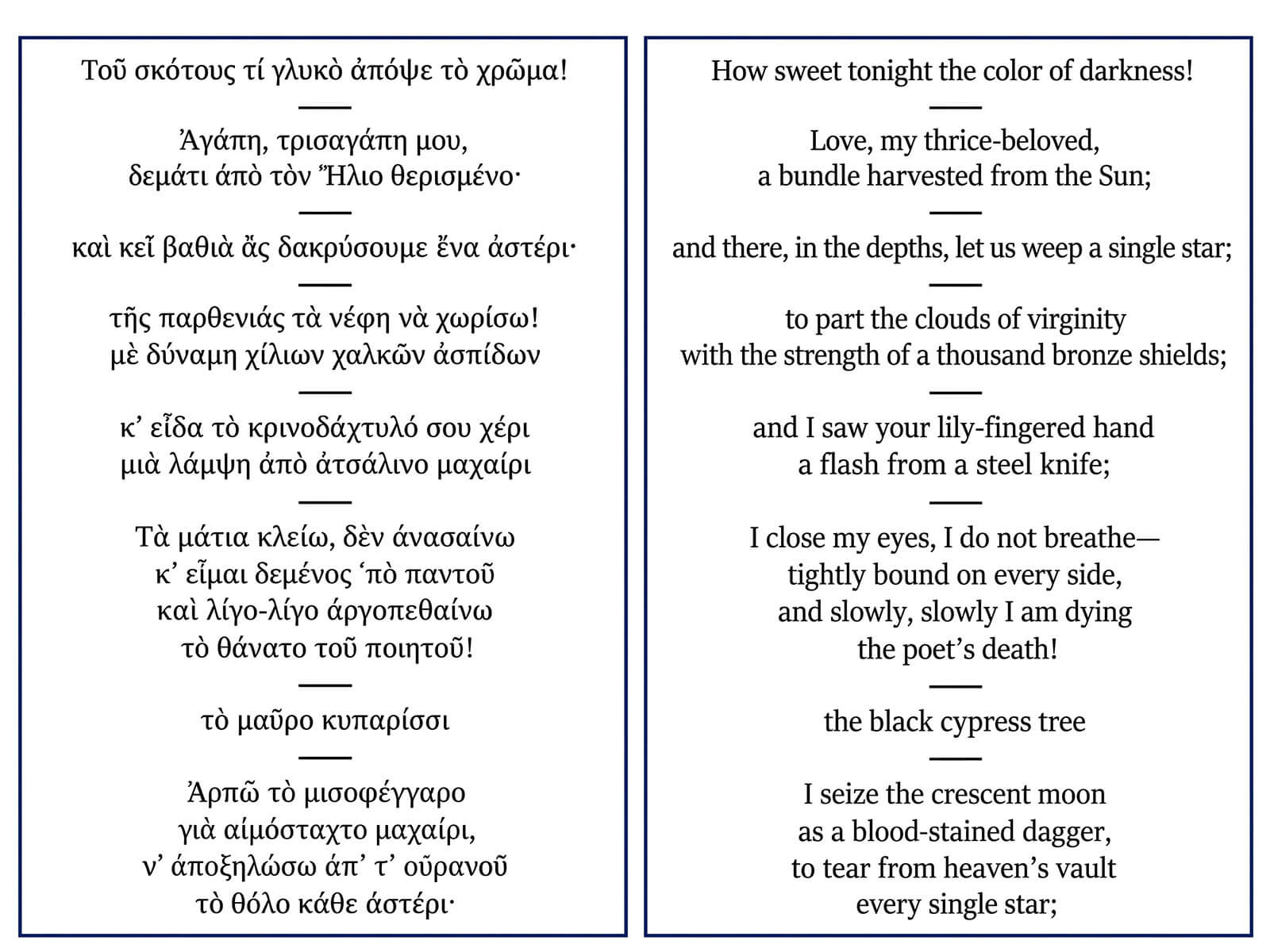
[2.5] Kērēthres (2008), scored for baritone/narrator, flute (alto and bass), piano, viola, cello, and tape, was commissioned by the present author for this recording project. For this composition, Antoniou selected short excerpts from eight poems by Kostas Varnalis, drawn from the third section of the poetry collection Kērēthres, titled “Songs of Darkness” (Tragoudia tou Skotous) (Varnalis 1985, 43–50; see Example 1). The work also takes its title from the same poetry collection.
Example 1. Selected excerpts from the third section (“Songs of Darkness”) of the collection Kērēthres by Kostas Varnalis. The translations of the excerpts were undertaken by the author.
3. Aim, Methodological Premises, and Observations
[3.1] The present study examines Theodore Antoniou’s Kērēthres as a composition in which the alternation of modal and chromatic fields, the transient emergence of tonal centers, and melodic-harmonic ambiguity give rise to an environment of harmonic suspension and formal fluidity. More specifically, the first section of the work is approached as a characteristic instance in which tonal centricity,[10] rather than being established as a stable axis of orientation, emerges, is called into question, and is continually redefined through modal alternation and mixture, pitch attractions, and unconventional cadential behavior.
[3.2] The methodological approach adopted here is integrative, focusing on the ways in which the pitch material acquires, loses, or shifts its orientation over the course of the work’s formal unfolding. Particular attention is given to the alternation of modal and chromatic regions, melodic directionality, pitch focalization, and the processes through which cadential arrivals are prepared, deferred, or weakened. Rhythmic organization is also examined in relation to different modes of vocal delivery and the temporal articulation of poetic language, with particular attention to how “narrative rhythms” contribute to the shaping of musical form. The internal articulation of the subsections, texture, and timbre are also taken into account insofar as they contribute to the overall sense of instability, suspension, and formal openness.
[3.3] Pitch-class set theory is not adopted as the principal analytical tool, not because it would be inherently inapplicable to the work, but because its emphasis on the abstract intervallic identity of pitch-class sets would draw the analysis away from the ways in which the material acquires musical significance over the course of the work. Moreover, such a methodological choice could obscure the distinctions between occurrences of the same or closely related pitch material, whose significance varies according to their position within the musical flow and the unfolding of the form.[11]
[3.4] At this point, the use of the term “voice leading” also requires clarification. In the present analysis, voice leading is understood more broadly than the practice of part-writing within the framework of functional harmony. It denotes the manner in which the vocal line and the individual instrumental lines organize pitch motion, locally projecting particular pitches as points of departure or as potential cadential goals. In this sense, voice leading concerns both the internal trajectory of a melodic line and its relationship to the harmonic and pitch environment within which it unfolds. The qualifier “ambiguous” captures precisely the instability of this directional process: the musical writing generates expectations of orientation toward particular pitches, although these expectations do not invariably culminate in the cadential confirmation of a clearly defined tonal center. They are frequently deferred, displaced, or weakened through chromatic compression, transitions between modal environments, and alternative cadential trajectories. Accordingly, “ambiguous voice leading” remains distinct from tonal centricity: it designates the linear and melodic-harmonic processes through which an orientation toward a tonal center is projected, called into question, and ultimately left suspended.[12]
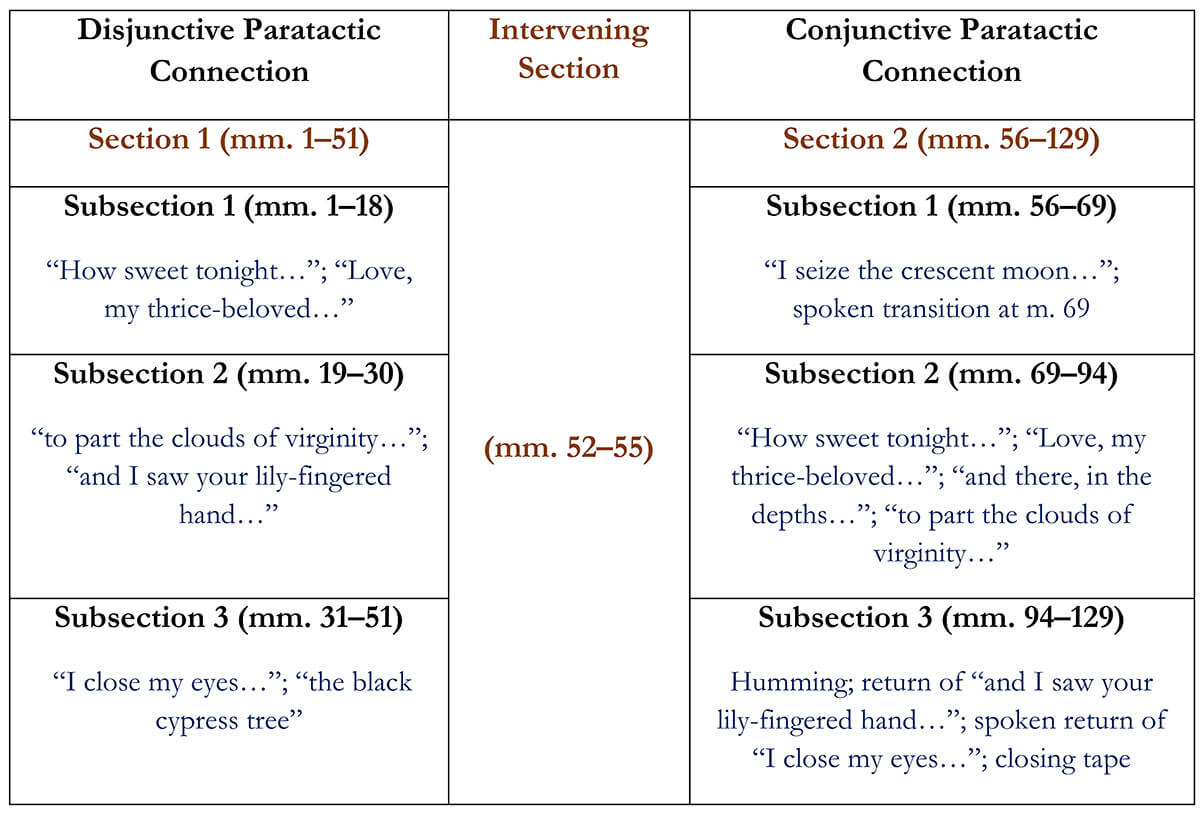
[3.5] The elliptical selection of poetic material serves as a point of departure for the construction of a paratactic form. The work’s formal organization is shaped by a horizontal succession of sections, with disjunctive connections between the subsections of the first section (mm. 1–51) and conjunctive connections between those of the second (mm. 56–129). In the first section, the subsections are articulated through distinct breaks in sonic continuity. In the second, the concluding sonic presence of one subsection carries over into the opening of the next, creating a sense of continuity through the persistence of sound. This process is evident in the spoken passage at m. 69 and the sustained flute multiphonic at m. 94, which extends into the following measure (see Table 1). This paratactic design may be understood in relation to a distinctly theatrical mode of organization, based on the juxtaposition of successive states of utterance. The poetic excerpts are articulated outside the logic of continuous narrative progression; each individual state reconfigures the relationship among language, voice, timbre, and pitch focalization. The form of Kērēthres thus emerges as a succession of vocal and sonic events, in which the paratactic arrangement of the poetic excerpts activates different qualities of vocal presence and sonic space.[13]
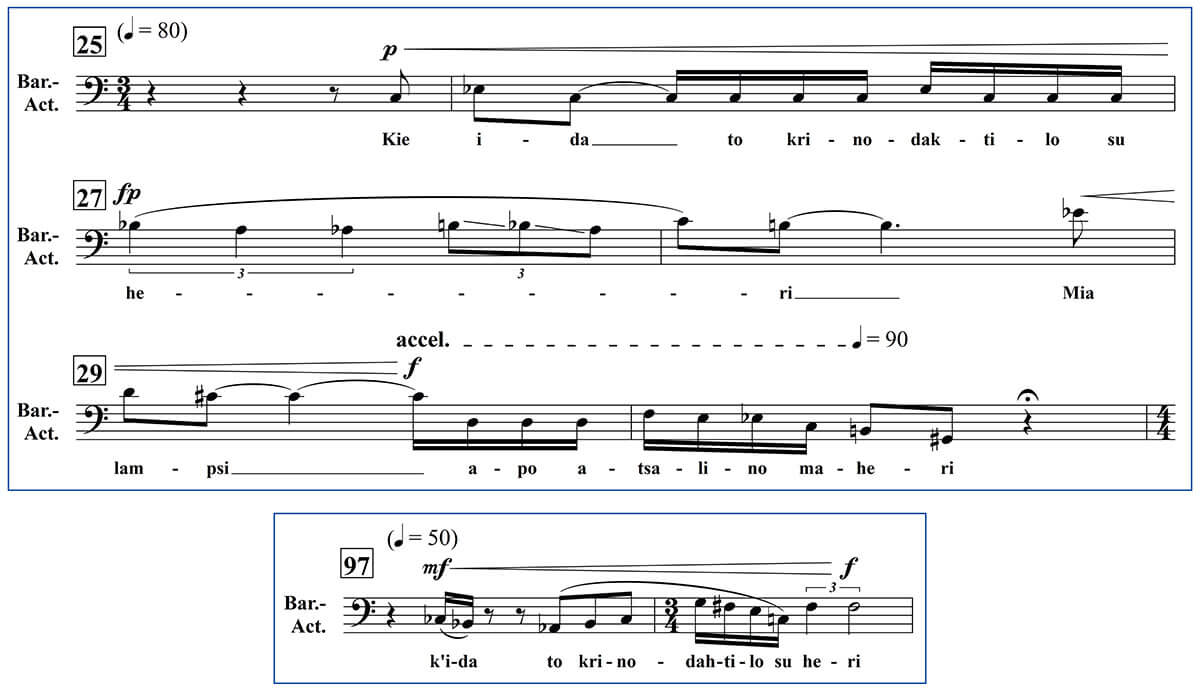
[3.6] The analysis focuses primarily on the first section of the work (mm. 1–51), while selected later regions of the composition are considered insofar as they contribute to a fuller investigation of its pitch, rhythmic, dramaturgical, and formal organization. By way of introduction, it is worth noting that Antoniou draws on techniques for handling poetic text that had by then become firmly established in his compositional practice. One characteristic feature is the selective return of previously heard poetic material, at times in a more abbreviated musical setting (see Example 2). Another is the use of spoken delivery, usually following the musical setting of verses that are subsequently repeated in recited form (see Example 3).[14] The recited repetition may also serve to make their meaning clearer. This alternation between sung utterance and recitation lends the work a distinct dimension of vocal dramaturgy, rooted in the theatrical foundations of Antoniou’s compositional practice. The voice moves between singing, recitation, and expressive gesture, activating the poetic text as an act of utterance.
Table 1. Formal structure of Kērēthres, showing the disjunctive connections between the subsections of the first section and the conjunctive connections between those of the second. The poetic material and modes of vocal delivery are indicated in abbreviated form.
Example 2. Presentation of the phrase k’ eida to krinodachtylo sou cheri (“and I saw your lily-fingered hand”) in its extended and abbreviated musical settings, respectively.
Example 3. Repetition of the poetic text in spoken declamation, immediately following its musical setting.
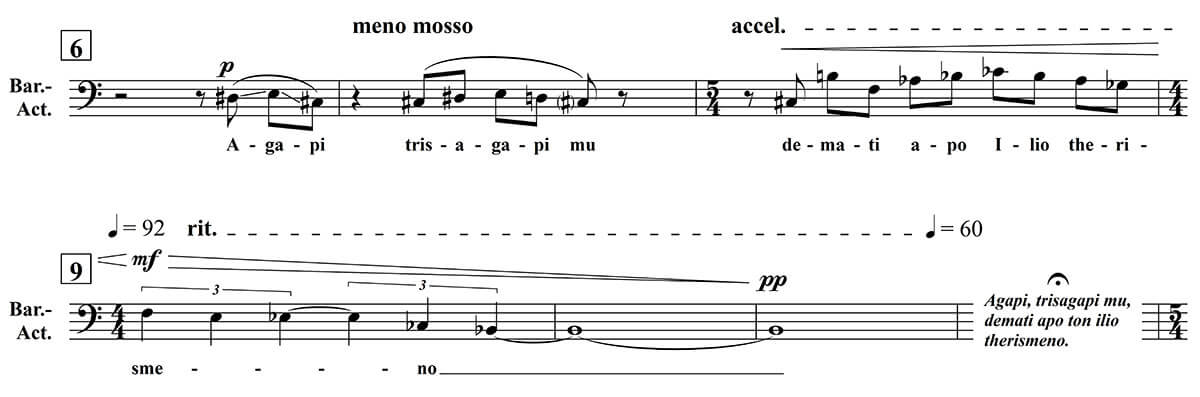
4. Analysis of the First Section (mm. 1–51)
Subsection 1 (mm. 1–18)
[4.1] Immediately following the opening spoken declamation (prose), the pitch material is consistently drawn from the C-minor scale, with the appearance of D♭ imparting a Phrygian quality—a manifestation of modal fluctuation (Persichetti 1961, 40). The configuration of the sonorities, however, neither privileges any particular pitch nor establishes a clear tonal orientation. A fleeting sense of C as a tonal center nevertheless arises from the solo cadential gesture of the bass flute, reinforced by an emphatically articulated descending leading-tone attraction[15] from D♭ to C through the use of flutter-tonguing. The ephemeral impression of this tonal center results not only from its limited preparation, but also from the frustration of the expectation that it will prepare the tonal environment of the ensuing vocal entry. Consequently, the vocal part’s shift to C♯ minor in m. 6, though unexpected, is not perceived as jarring, owing to the weak cadential function of the preceding passage.
[4.2] The opening verse, “How sweet tonight the color of darkness!”, initially delivered as spoken declamation, evokes a distinctive synesthetic image, intertwining the visual experience of darkness with the sensation of sweetness. This poetic ambiguity acquires an additional expressive dimension in the transition from the opening declamation to the first sung statement of “Love, my thrice-beloved.” In the intervening instrumental passage, the bass flute’s fleeting projection of C creates an expectation of tonal continuity that is not fulfilled when the baritone enters in C♯ minor in m. 6. Yet the weak cadential function of the preceding instrumental passage allows this shift to be perceived without a sense of abrupt rupture. The frustration of the initial tonal expectation may thus be understood in relation to the unusual conjunction of darkness and sweetness, lending the musical transition an expressive quality that resonates with the ambiguity of the poetic text.
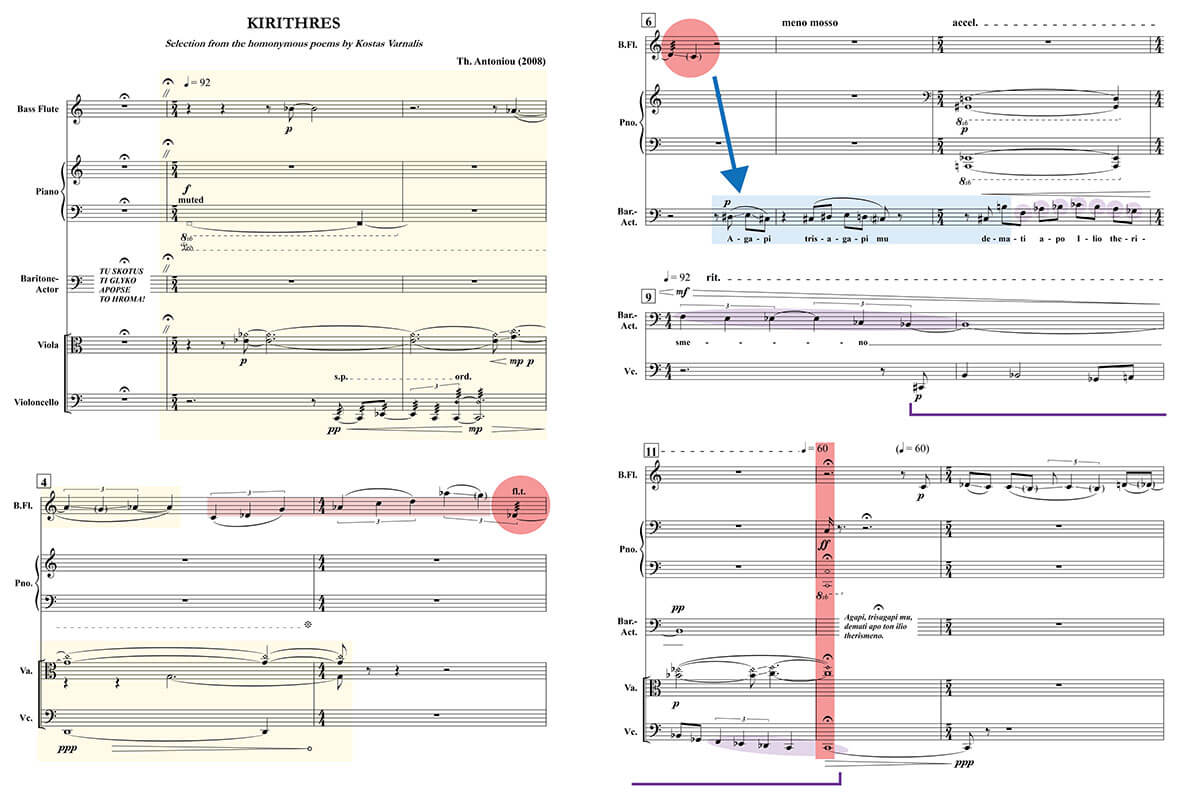
[4.3] A comparable sense of tonal instability appears to be sought immediately thereafter, during the transition to the Locrian mode on F. More specifically, while the chromatically compressed cadence of the vocal part in mm. 9–10 leads to the fourth melodic degree of the mode, B♭, the cello imitatively reproduces the baritone’s chromatic environment at a phase displacement, through a more widely spaced melodic rhythm. This relationship between the voice and the cello lends the passage a dramaturgical dimension, as the instrument functions as a sonic extension of the vocal utterance, repeating, slowing, and displacing its chromatic trace. In this way, the instrumental writing contributes to the formation of a theatrically charged environment in which the voice is surrounded by sonic responses and temporal reflections. The cello’s arrival on C, articulated through a descending Locrian pentachord in m. 12, does not merely constitute an alternative cadential path, achieved smoothly and unobtrusively through the shared pitch content resulting from the use of the Locrian mode on F and, subsequently, on C. Rather, it contributes to the formation of a tonally unstable region through successive pitch focalizations situated in close intervallic proximity (see Example 4).
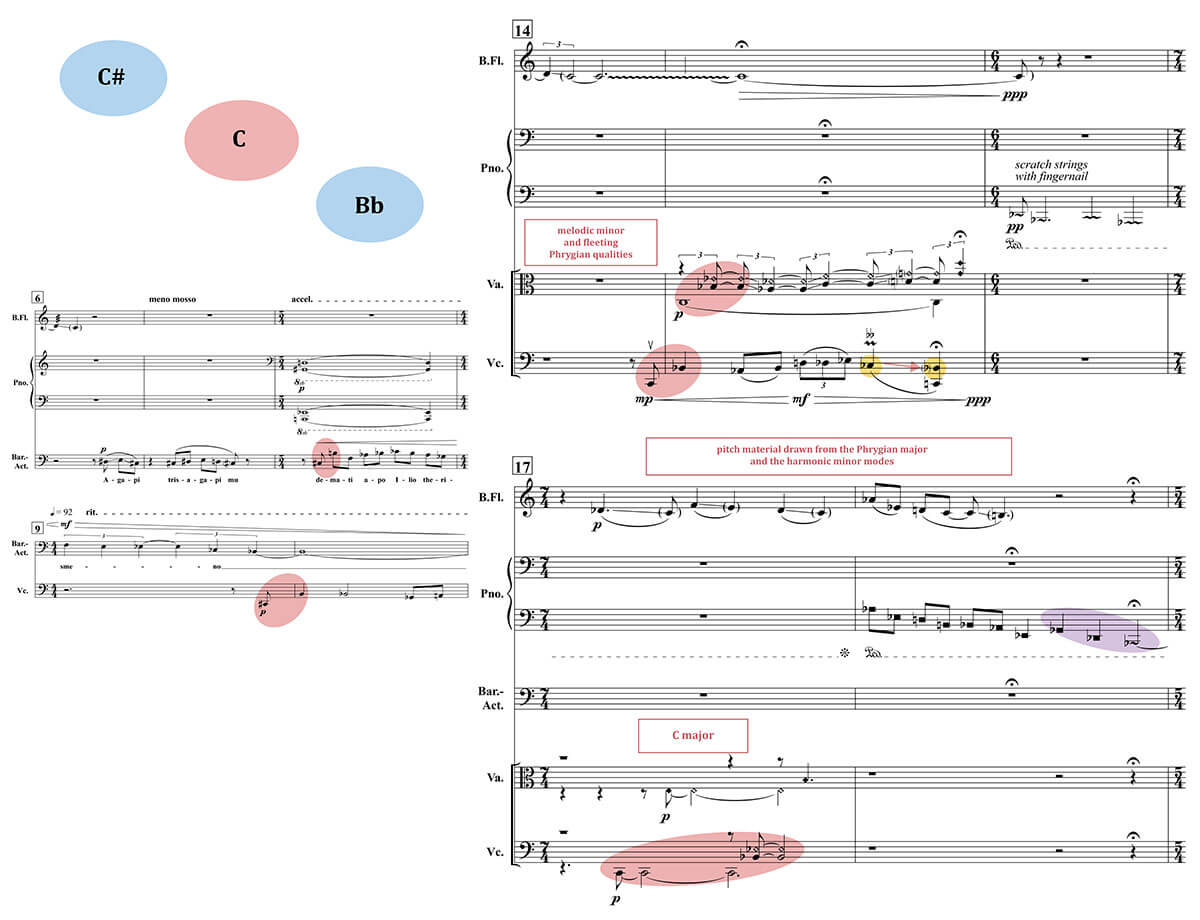
[4.4] Indeed, B♭ and C♯ (D♭) function essentially as satellite pitches around the tonal center C, giving rise to fleeting focalizations, while C emerges as the prevailing tonal center from m. 12 onward, remaining the principal point of reference until its dissolution at m. 45. The earlier melodic presentation of the minor seventh C♯–B, at the opening of the baritone’s phrase in m. 8 and in the corresponding cello figure in mm. 9–10, lends familiarity to the interval’s subsequent harmonic role, when it appears as C–B♭ in the cello in m. 15, broadening the sonic presence of C and accounting for the attraction that the tonicization of B♭ may exert. Although the tonal center is clearly perceptible, the harmonic field remains expanded. Characteristic instances of this relatively mild harmonic and melodic heterogeneity include the combination of the major, harmonic-minor, melodic-minor, and Phrygian major modes, as well as a timbrally varied chordal unfolding of G♭ major[16] in the piano in m. 18 (see Example 5).
Example 4. The weak tonal orientation in the opening region (yellow shading) is followed by an initial approach to the tonal center C (light and dark red shading), which, however, does not inform the baritone’s first entrance (blue shading). The purple shading in the vocal line—and the corresponding demarcation in the cello—indicates the use of pitch material drawn from the Locrian mode on F.
Subsection 2 (mm. 19–30)
[4.5] The unstable G♭-major sonority of m. 18 suggests that Antoniou may once again be seeking to undermine tonal clarity, an impression reinforced when the musical narrative resumes. Indeed, harmonic suspension appears to be a compositional priority and at the same time creates a renewed opportunity for the tonal center to be “claimed” and approached anew. Thus, although mm. 19–21 create the impression of a tonal shift that seems to initiate melodic and harmonic development in a different tonal region, the same passage also undertakes a delayed reapproach to the tonal center C. As the texture becomes denser through more active instrumental participation, the vocal line unfolds through successive conjunct pentachords, drawing on pitch material from the harmonic and melodic forms of B♭ minor. By contrast, the melodic motion in the bass flute and cello is characterized by rhythmic fluidity and a certain neutrality, suggesting a diatonic pitch collection that gradually acquires a clearer orientation toward the tonal center C.
Example 5. The prevailing tonal center and the surrounding satellite pitches, whose temporary prominence exemplifies pitch focalization. The minor seventh (red shading) expands the harmonic field surrounding the tonal center C. The purple shading indicates the chordal unfolding of IV/N.
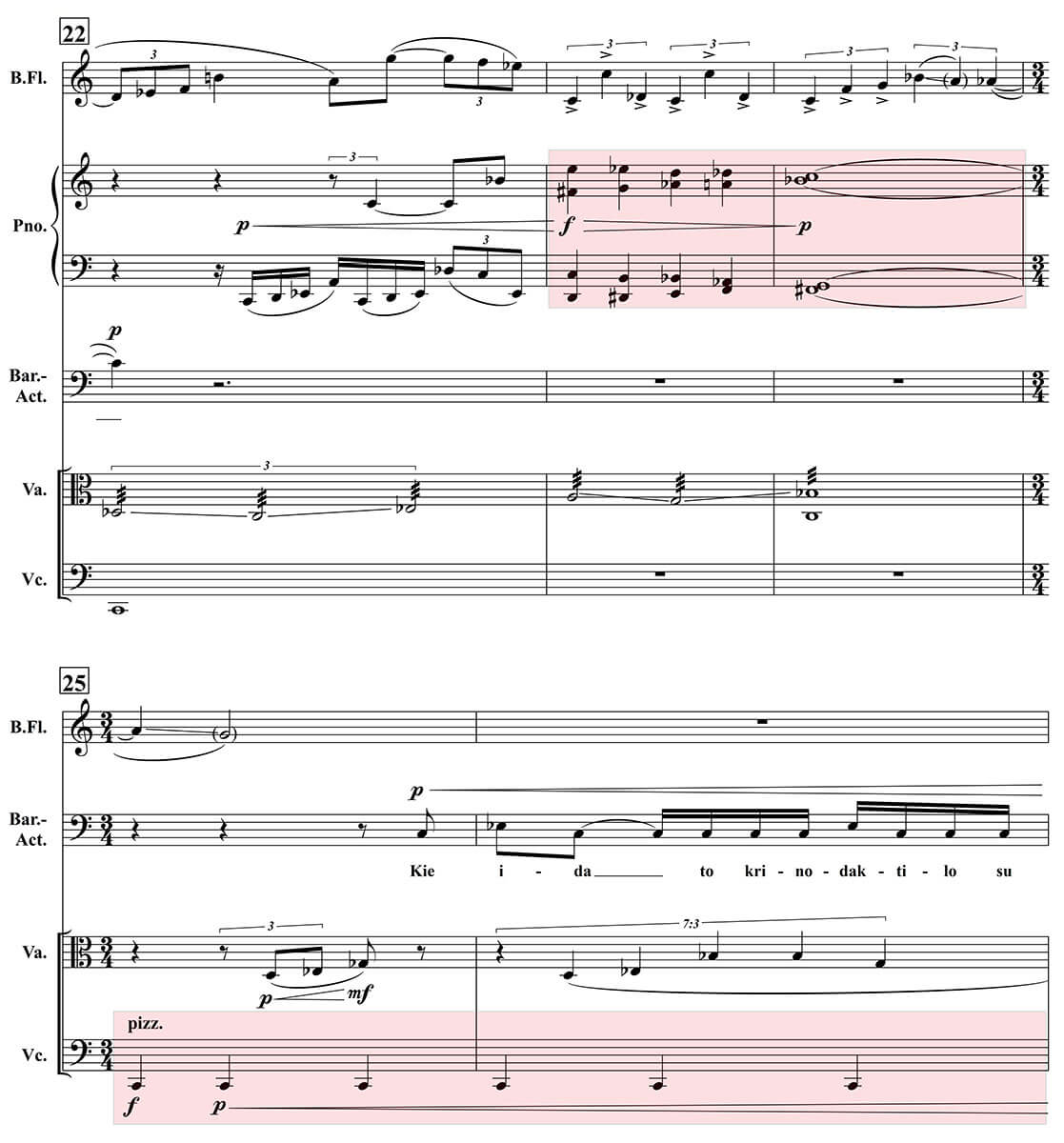
[4.6] The bimodal environment of mm. 19–21 gradually acquires a unified harmonic identity through the combination of two modal subsets—a lower Phrygian pentachord on C (C–D♭–E♭–F–G) and a conjunct upper Dorian tetrachord on G (G–A–B♭–C). Although the entrance of the piano initially appears consistent with this modal configuration, it subsequently introduces a perhaps unexpected chromatic development. Particularly noteworthy is the function of this chromatic material, which serves not to undermine the diatonic fabric but to prepare a “narrative rhythm.”[17] In other words, the contrary chromatic motion of simultaneously sounding dyads invests the motion in fourths with structural significance, thereby anticipating the rhythmically articulated drone that appears in the cello in mm. 25–30 (see Example 6). Solo phrases in the viola culminate in a syncopated rhythmic figure that unfolds in rhythmic displacement against the cello, while semitonal three-note fragments in the vocal part move progressively upward, contributing to the intensification of tension and to a sense of melodic suspension. The vocal line in mm. 25–30 provides a characteristic instance of ambiguous voice leading: although its melodic unfolding initially creates the impression of a directed trajectory, the gradual chromatic compression[18] and acceleration of the vocal delivery weaken the expectation of an unequivocal cadential confirmation.
Example 6. The chromatic motion of the voices in the piano in m. 23 prepares the quarter-note pulse in the cello in mm. 25–30.
Subsection 3 (mm. 31–51)
[4.7] The opening measures of the third subsection (mm. 31–35) are characterized by the presence of short instrumental phrases. Without departing from the tonal center C, and within a moderately expanded harmonic environment shaped by the alternation of related modes and mixed modal subsets—the Phrygian mode on C, C harmonic minor, a lower Phrygian pentachord on C (C–D♭–E♭–F–G) with a conjunct upper Dorian tetrachord on G (G–A–B♭–C), and a descending tetrachord with an octatonic inflection, F♭–E♭–D♭–C, arranged in a semitone–whole-tone–semitone pattern—the composer turns toward a form of timbral pluralism arising from specific instrumental techniques and behaviors. Artificial harmonics and tremoli in the viola, together with portamenti in the flute, coexist with the seagull effect in the cello, the striking of the lower strings of the piano with the hand to produce a tom-tom effect, and the percussive articulation of piano tones combined with the suppression of their overtones through palm muting. These choices enrich the timbral palette and give perceptible form to a wordless sonic atmosphere whose expressive force is reinforced by the fragmentary character of the phrases.
[4.8] The semitonal friction (E–F) that emerges in the low strings in mm. 36–37 constitutes not only a textural differentiation but also an idiomatic means of temporarily foregrounding F, in the manner of a tonicization. This leading-tone relationship thus prepares the shift of the vocal part—Ta matia kleiō, den anasainō (“I close my eyes, I do not breathe”)—to F, a perfect fourth above the prevailing tonal center C. The pitch material of the voice is drawn from the Dorian scale with a raised fourth, also known as the Ukrainian Dorian scale or altered Dorian scale (Slobin 1982, 551–52),[19] while the fleeting appearance of G♭ does not serve to expand the scale’s pitch content but reflects a momentary pitch attraction. Although the bass flute line accompanying the voice likewise draws its pitch material from the aforementioned scale, its voice-leading direction foregrounds the tonal center C in mm. 38–41. This subtle tonal ambiguity is further intensified by the fluidity generated by the descending chromatic motion at the close of the vocal line in mm. 38–39, on the words den anasainō (“I do not breathe”).
[4.9] The syllabic distribution and interlaced rhyme that characterize the quatrain of the sixth excerpt (see Example 1) find a musical parallel in Antoniou’s use of related pitch collections for the setting of the second couplet. Indeed, in the vocal line in mm. 41–45, the composer combines material drawn from the acoustic, or overtone, scale with selected pitch inflections associated with the Hungarian minor scale,[20] returning to the tonal center C, which has thus far prevailed, with the aforementioned contribution of the bass flute in mm. 38–41 and its emphatic confirmation by the piano in m. 41. The baritone’s arrival on D♭ in m. 45 (see Example 7), rather than on the expected pitch of the tonal center, C, creates a parallel with the unexpected choice of tonal environment—C♯ minor—at the voice’s first entrance. As noted above, that earlier choice afforded a relatively smooth continuation of the musical narrative, owing to the preceding, ultimately unsuccessful attempt to establish C as a tonal center in the opening measures of the work (mm. 1–6). The descending chromatic motions in the flute, piano, and viola contribute to the dissolution of C as the prevailing tonal center, a process that reaches its dramaturgical release in the striking of the lowest piano strings with the hand.
Example 7. Ambiguous voice leading and the voice’s unexpected arrival on D♭ instead of the anticipated convergence on the tonal center C (mm. 41–45).
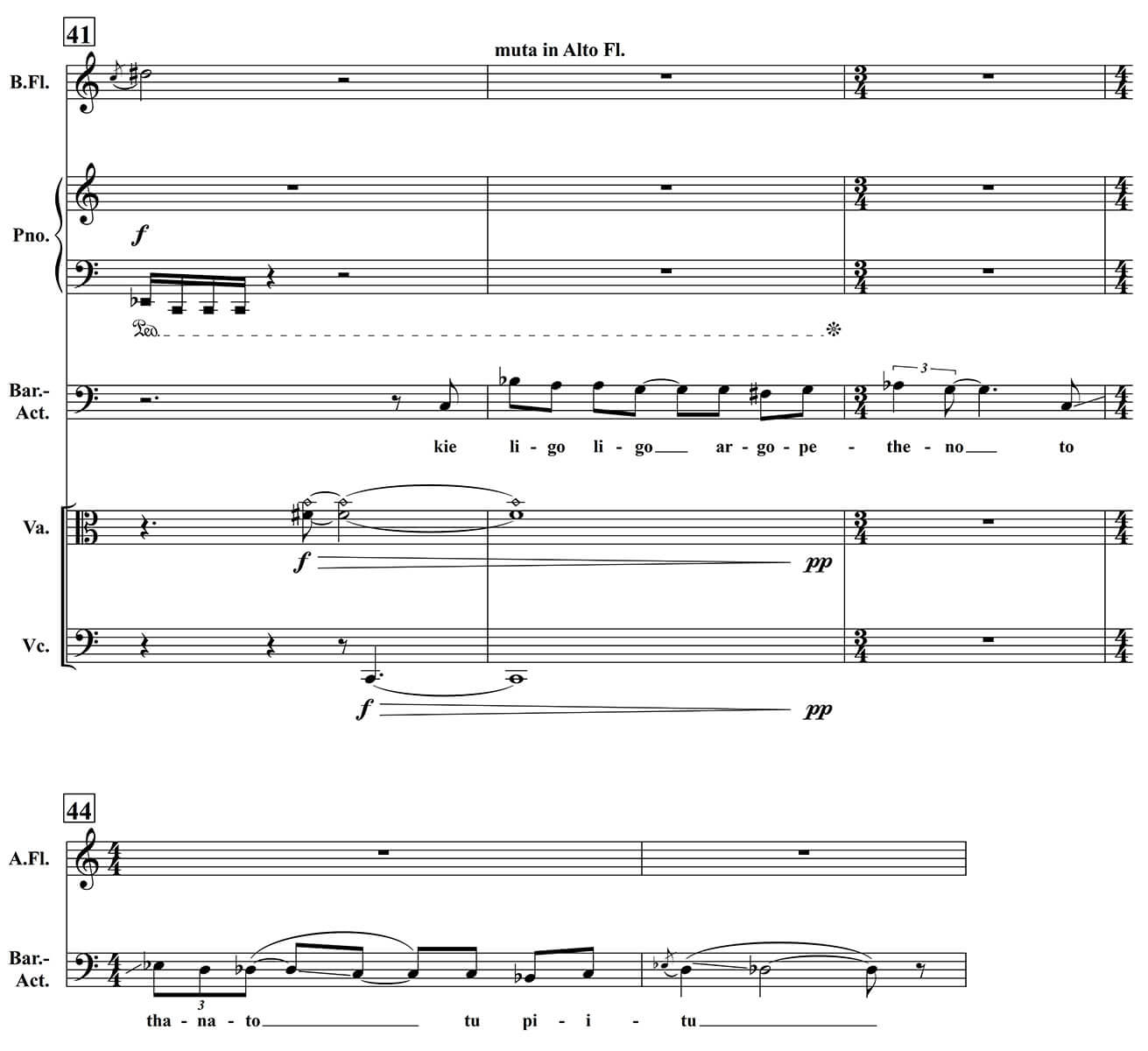
[4.10] The tonal deviation illustrated in Example 7 also participates in a broader relationship between the musical setting and the poem’s imagery of death. The words “and slowly, slowly I am dying / the poet’s death” accompany the process whereby the anticipated return to the tonal center C is deflected by the baritone’s arrival on D♭ in m. 45. Shortly thereafter, the image of “the black cypress tree” is delivered in a whisper (pp, mm. 47–48), as pitched vocal delivery gives way to an attenuated form of spoken utterance. The alto flute’s chromatically inflected continuation, marked accel. molto and gradually diminishing toward pp, extends this transformation into the instrumental writing. Through this succession, the weakening of tonal orientation finds a continuation in the changing modes of vocal delivery and the gradual attenuation of the instrumental sound.
5. The Intervening and Second Sections as Extensions of the Principal Analytical Axes
[5.1] Although the present analysis focuses primarily on the first section of the work, a brief consideration of the intervening section (mm. 52–55) and of selected features of the second section (mm. 56–129) allows the three principal axes of the analytical approach—ambiguous voice leading, “narrative rhythms,” and suspended harmony—to be traced in the continuation of the work, where they recur in transformed form.
[5.2] The intervening section, in mm. 52–55, is organized as a region of temporal and harmonic suspension (see Example 8). The voice is absent, and the musical process is shaped exclusively by the instruments, with the result that attention is now focused on pitch organization, timbral relationships, sustained sonorities, and temporal articulation. The numbered entries, freely shaped durations, and the indication “very slow & very irregular cues” distance the music from continuous metric flow and clear linear direction. Within this open temporal environment, the pitch succession unfolding in the piano and flute may be understood as a sequence of three four-note subsets.
[5.3] More specifically, the passage comprises a four-note subset of the octatonic collection (B–E–D–D♭/C♯), a diatonic subset with a clearly pentatonic profile (C–B♭–A♭–F), and a diatonic subset with a minor inflection and Phrygian coloring (F♯–G–A–C♯). The three subsets are linked through the successive semitonal transposition of a perfect-fourth relationship (B–E, C–F, and C♯–F♯). Through this succession, the material moves from chromatic contraction and octatonic articulation toward a more distinctly diatonic pitch field, without relinquishing its underlying instability. In the cello and viola, natural and artificial harmonics, combined with pitches produced in the ordinary manner, do not function merely as timbral additions but participate actively in the pitch organization of the passage. At times they align with the pitches of the individual subsets; at others, they sustain earlier pitch references within the sonic field, while also discreetly preparing the sonority in m. 55, in which the octatonic relationships of the passage are brought together.
[5.4] Indeed, selected pitches from this succession coalesce in m. 55 into a composite sonority comprising a complete octatonic collection and an additional F♯. The eight pitch classes C♯–D–E–F–G–A♭–B♭–B constitute the octatonic component, whose realization is timbrally differentiated: C♯ is projected by the bass flute and also appears in the F♯–C♯ sonority in the viola, produced through natural harmonics, while D–E–F–G–A♭–B♭–B form a weaker, almost dematerialized layer through the piano harmonics. The viola’s F♯ lies outside the octatonic collection and preserves a pitch from the preceding F♯–G–A–C♯ subset. Its combination with C♯ thus connects the preceding material to the sonority of m. 55 while introducing an additional pitch beyond the octatonic collection. In the cello, the fifth G–D, entirely contained within the octatonic collection, provides the low foundation upon which a faint dominant-seventh profile, G–B–D–F, emerges. The two fifths, F♯–C♯ and G–D, displaced by a semitone, further complicate the pitch orientation of the sonority. Yet because the pitches that complete the dominant-seventh formation arise primarily from the attenuated layer of piano harmonics, the dominant remains an allusive harmonic shadow within the octatonic collection, without acquiring a conventional cadential direction. The sonority thus assumes the character of suspended harmony: octatonic completeness coexists with an additional pitch outside the collection, the dominant-seventh quality suggests an unfulfilled direction, and the prominently projected C♯ chromatically displaces the anticipated point of arrival.
Example 8. The intervening section as a region of temporal suspension and suspended harmony, mm. 52–55.
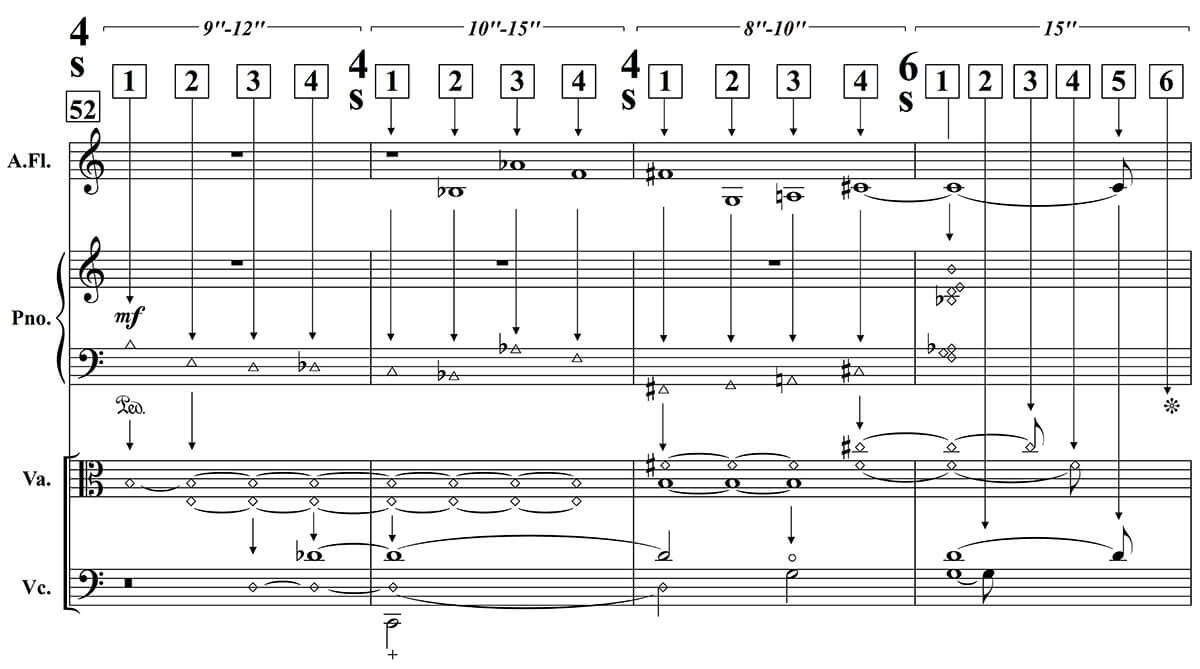
[5.5] Joseph N. Straus’s approach is particularly well suited to interpreting this configuration, since it brings together the distinction between tonality and centricity and the concept of referential pitch collections. In m. 55, the complete octatonic collection functions as the principal referential pitch field within a broader sonority that also includes F♯. The timbral projection of C♯ and the two perfect-fifth relationships—G–D in the cello, with both pitches contained within the octatonic collection, and F♯–C♯ in the viola, with F♯ lying outside it—generate local centric tendencies. The emerging dominant-seventh quality, G–B–D–F, can be understood as a familiar chordal formation embedded in the octatonic collection itself, without activating a functional resolution. The harmonic suspension of the passage arises precisely from this coexistence: complete octatonic organization, attenuated timbral articulation, an implied dominant-seventh sonority, and the timbral projection of C♯, which displaces by a semitone the anticipated resolution toward C suggested by the dominant-seventh quality.[21]
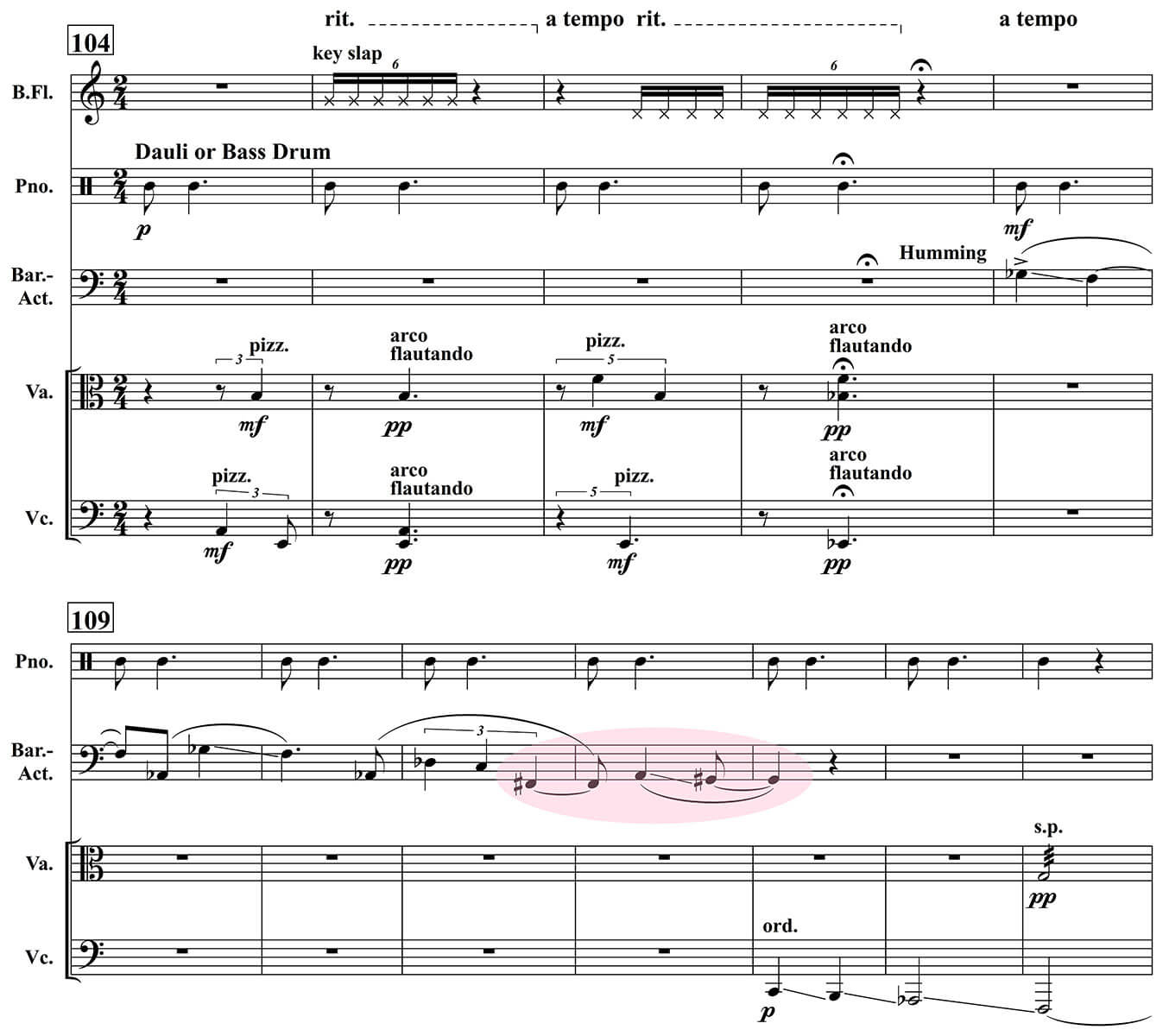
[5.6] In mm. 104–15, ambiguous voice leading and the “narrative rhythm” return under different conditions (see Example 9). At this point, the pianist temporarily leaves the keyboard and is instructed to perform a recurring eighth-note–dotted-quarter-note figure on either the daouli (a traditional Greek double-headed cylindrical drum) or the bass drum. This timbral differentiation, together with the steady repetition of the figure, reinforces its role as a subtle support for the vocal line, helping to sustain its uninterrupted flow. The vocal line now unfolds without poetic text, in the form of humming. In contrast to mm. 25–30, where the increasing density of verbal articulation and the indication accel. propelled the phrase toward heightened expressive intensity, here the “narrative rhythm” provides unobtrusive support for a gentle and steady vocal trajectory.
[5.7] Ambiguous voice leading emerges in the same region through the divergence between the expected pitch of arrival and the actual course of the vocal line. F is projected as a potential cadential goal. This projection arises from the sounding succession A♭–D♭–C, after which a hypothetical continuation through G♭ to F is implied (mm. 110–13). In m. 111, however, the projected G♭ is realized enharmonically as F♯, but instead of proceeding to the expected F, F♯ initiates an ascending minor third to A, followed by a semitone descent to G♯. The voice thus arrives on G♯, an augmented second above the expected F. This point of arrival keeps the memory of the initial pitch orientation active while simultaneously distancing the phrase from cadential confirmation. The cello’s semitonal descent, C–B–B♭–A, prolongs this ambiguity after the vocal line has come to rest, sustaining the sense of suspended harmony.
Example 9. Rhythmic support for the humming vocal line and ambiguous voice leading, mm. 104–15.
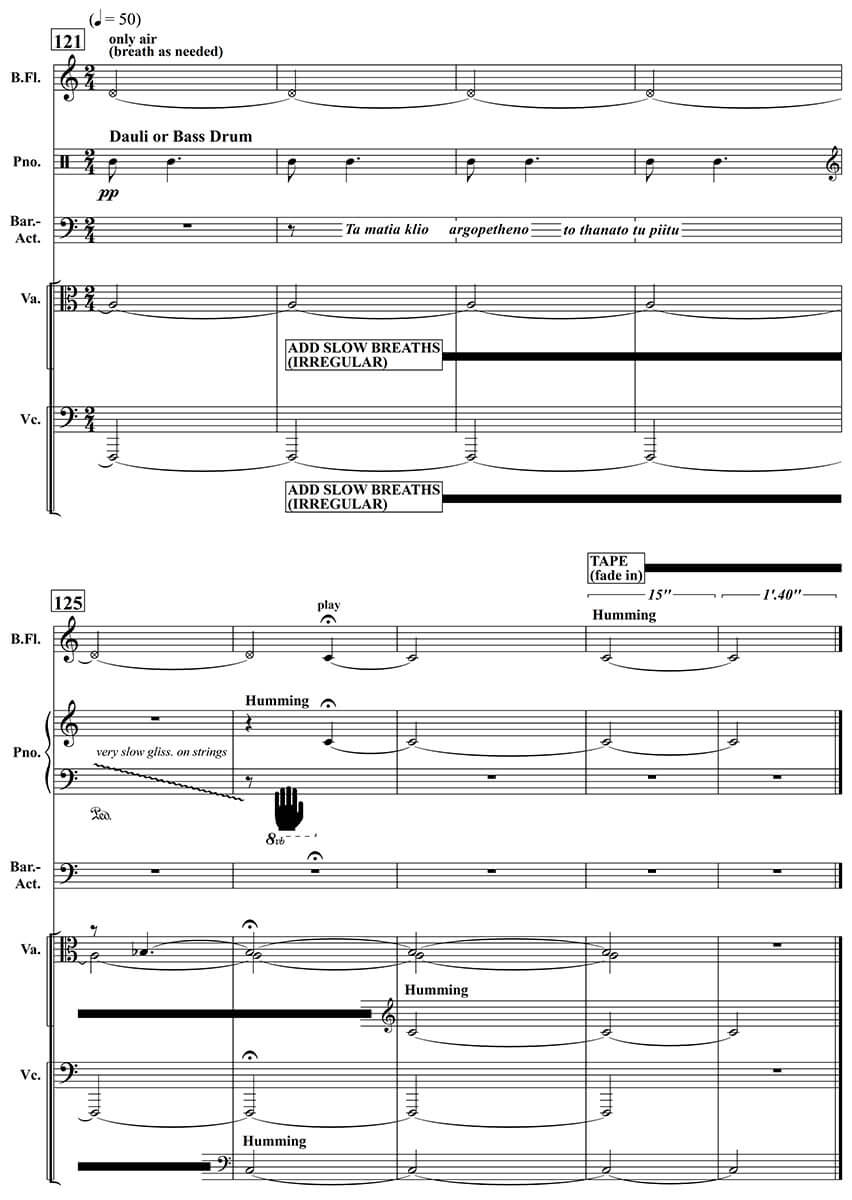
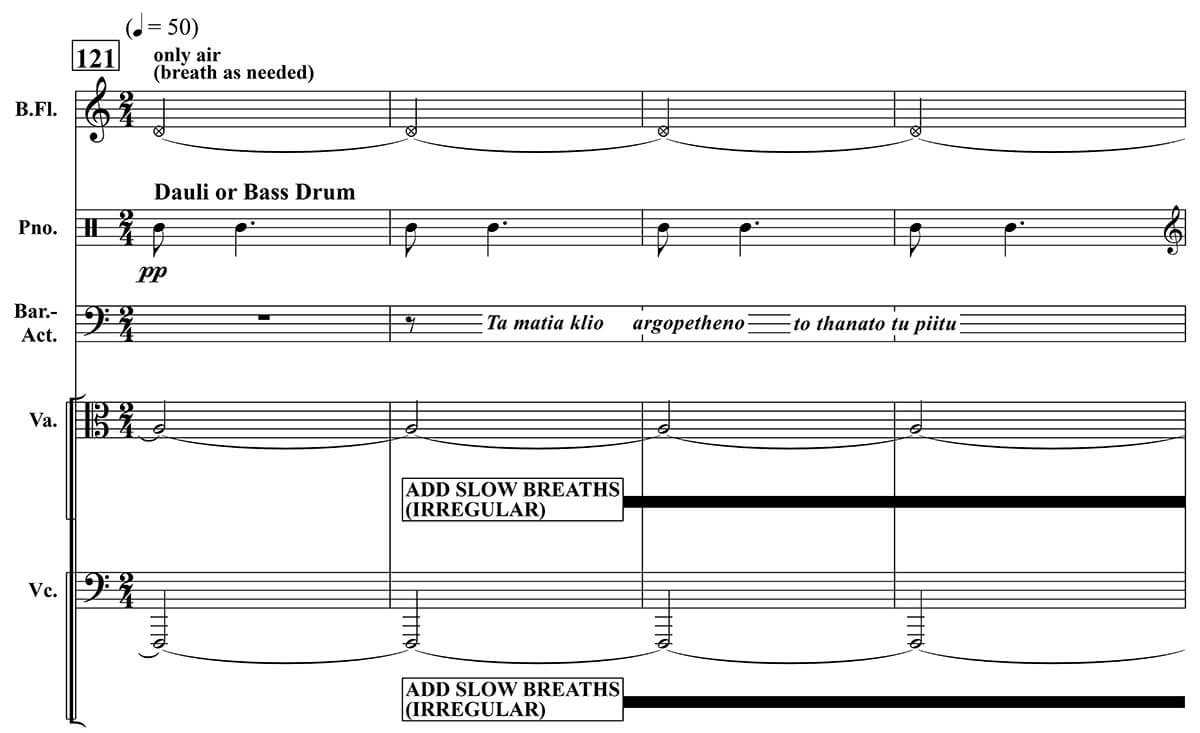
[5.8] The theatrical dimension of the work becomes still more pronounced in its concluding region (mm. 121–29), where the score indicates the entrance of the prerecorded material with the instruction “TAPE (fade in),” without notating its content (see Example 10). In the concluding passage, the live instrumental texture undergoes a gradual transformation: the bass flute is instructed to produce only air, while the viola and cello add slow, irregular breaths. In the final measures, a very slow glissando on the piano strings and humming further extend this transition from conventional instrumental sound toward breath and vocalized sonority. Both in the recording and in live performance, the tape was accompanied by a performance practice not specified in the score. In consultation with the composer, the instrumentalists used crystal glasses, tuned by means of appropriate quantities of water to the pitches of the glass harmonica—G, A, B, and C—in order to reproduce these pitches live in performance.[22] The melodic-rhythmic material of the glass harmonica is organized around the diatonic tetrachord G–C, with A assuming temporary prominence, thereby shaping a subtly modal environment that prolongs, at the work’s close, the sense of suspension and mnemonic recall. This practice carries the mnemonic dimension of the tape into the realm of stage action: by aligning the pitches of the glasses with those of the glass harmonica in the prerecorded material, the musicians render visible the otherwise unseen sonic environment of the tape. The concluding region thus acquires a distinctive theatrical presence, as the prerecorded sound is embodied in the actions of the performers.
Example 10. Theodore Antoniou, Kērēthres, mm. 121–29: concluding passage featuring air sounds, irregular breaths, humming, and the entrance cue for the prerecorded material (“TAPE (fade in)”).
6. “Narrative Rhythms”
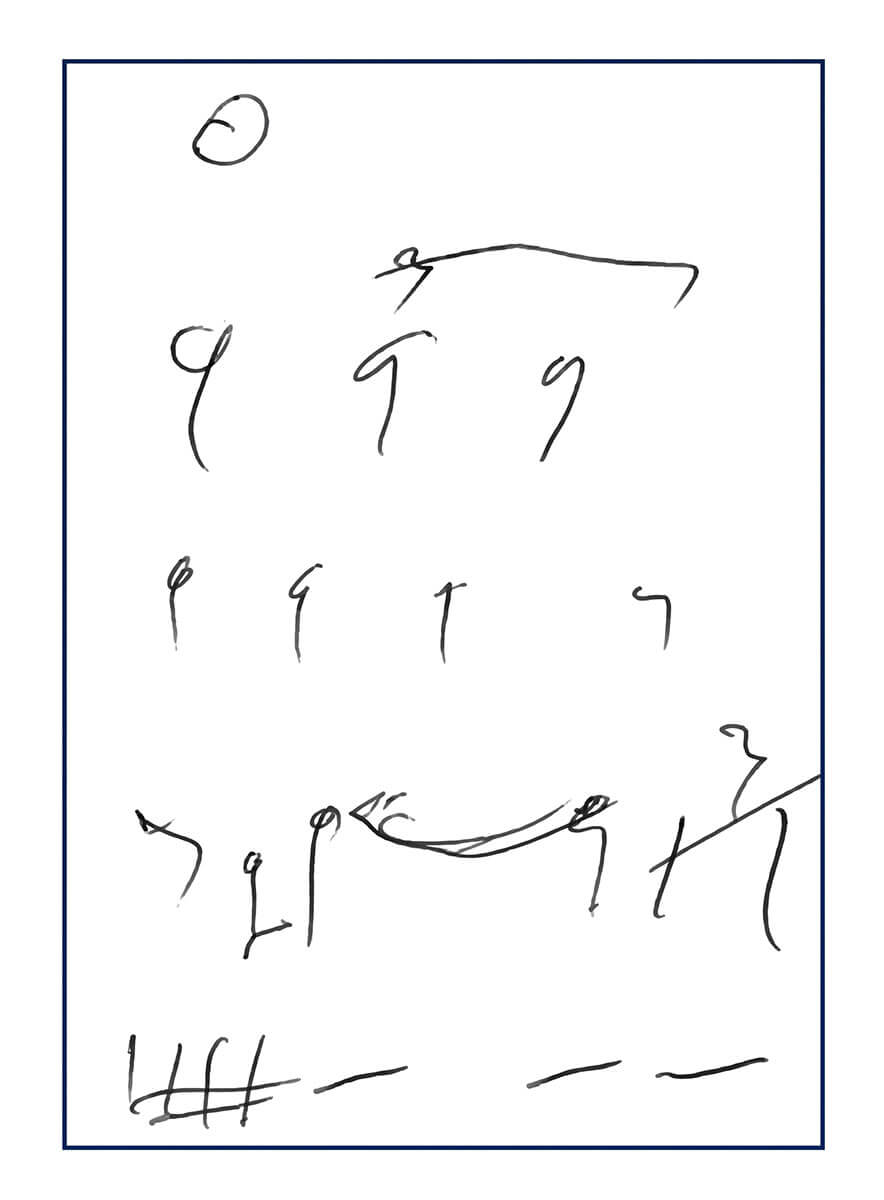
[6.1] The concept of the “narrative rhythm,” as used above, should be understood first and foremost as a term drawn from the vocabulary Theodore Antoniou himself used to describe his musical thought. In June 2013, in the course of a collaboration between the composer and the present author,[23] Antoniou remarked: “You know, I use ‘narrative rhythms’ in my music, mainly in my vocal works.” This prompted further discussion, during which the composer was asked to notate an illustrative example. Antoniou then wrote out a series of rhythmic figures, one beneath another (see Example 11). Although such rhythmic formations are not confined to vocal music, their narrative function may be understood here as emerging primarily in relation to the vocal line and the declamation of the text.
[6.2] The narrative dimension of such figures concerns the way in which they may unfold in tandem with the melodic line of the voice and contribute to the articulation and development of verbal and musical meaning.
Example 11. Theodore Antoniou’s autograph notation of rhythmic figures (13 June 2013).
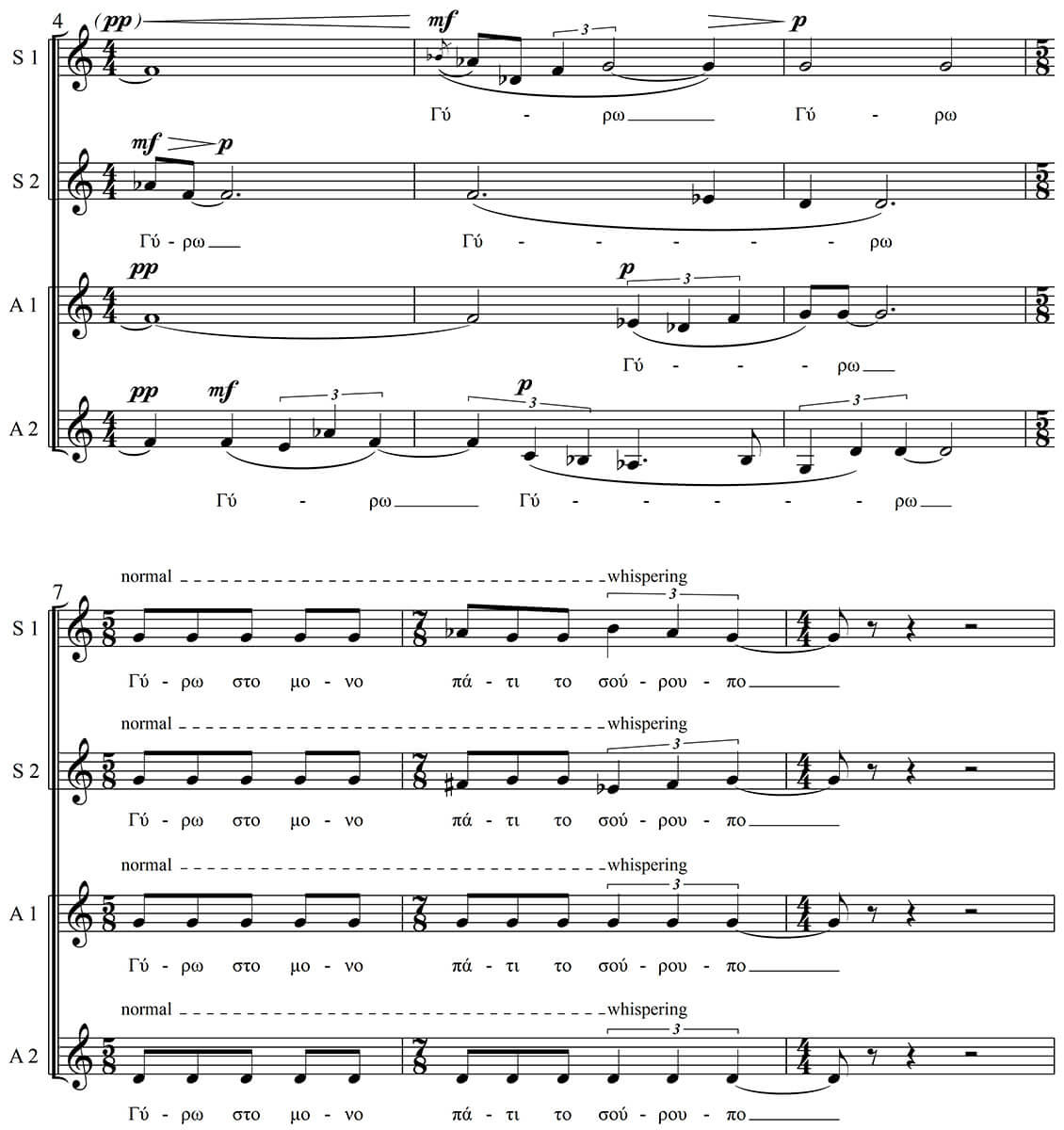
[6.3] This observation may be further illuminated by the opening section of Le Jardin des Rochers (2012), a work for four-part women’s choir and piano, likewise commissioned by the present author. At the beginning of the work, the word Gyrō (“Around”) (mm. 4–6) gradually emerges as both a sonic and verbal event within the four-part vocal writing. The voices articulate the word at different rhythmic rates, at times prolonging its constituent syllables and at others setting them in shorter note values or triplet figures. The word thereby acquires a temporal dimension, as the nonsynchronous articulation of the individual lines, their successive accumulation, and the progressive thickening of the texture lead from fragmentary utterance toward the collective articulation of the text. The transition to the homorhythmic delivery of the phrase Gyrō sto monopati to souroupo (“Around the path at dusk”) makes this trajectory explicit: from the gradual emergence of a single word to the unified projection of a complete semantic unit (see Example 12). In this instance, “narrative rhythms” are associated primarily with the temporal shaping of language within the choral writing: rhythm organizes the process through which a verbal unit emerges, gains density, and is ultimately integrated into a collective utterance.
Example 12. Theodore Antoniou, Le Jardin des Rochers, mm. 4–8: gradual emergence of the word Gyrō (“Around”) through rhythmically differentiated vocal entries and transition to the homorhythmic delivery of the phrase Gyrō sto monopati to souroupo (“Around the path at dusk”).
[6.4] From the perspective of a theoretical approach to rhythmic organization, such an analysis presupposes a distinction between the metric disposition of durational values and their rhythmic function. Cooper and Meyer define rhythm as “the way in which one or more unaccented beats are grouped in relation to an accented one,” while also emphasizing that rhythmic grouping does not necessarily coincide with the metric divisions marked by bar lines. The emphasis on grouping is crucial here, since it allows rhythm to be understood as a process through which musical events are articulated rather than as a mere succession of durational values. From the same perspective, particularly significant for the present approach is their view that rhythmic experience arises through the grouping of sounds into structured patterns and through the interaction among the musical parameters that shape their function (Cooper and Meyer 1960, 1, 6, 36). Since rhythmic grouping may, in turn, significantly shape melodic experience, a “narrative rhythm” may be understood as a rhythmic configuration that acquires significance within the specific context of the vocal line, the verbal content (where present), the harmonic environment, and the formal trajectory.
[6.5] The concept of “metrical or durational projection,” as developed by Christopher Hasty in Meter as Rhythm, can be applied here in a specific way. Hasty uses the term projection to describe a process whereby an already realized duration affects the way in which the temporal unfolding of the immediately succeeding event is perceived and anticipated. A rhythmic duration, in other words, does not function merely as a self-contained event; it can also shape the listener’s expectation of the continuation of musical time.[24]
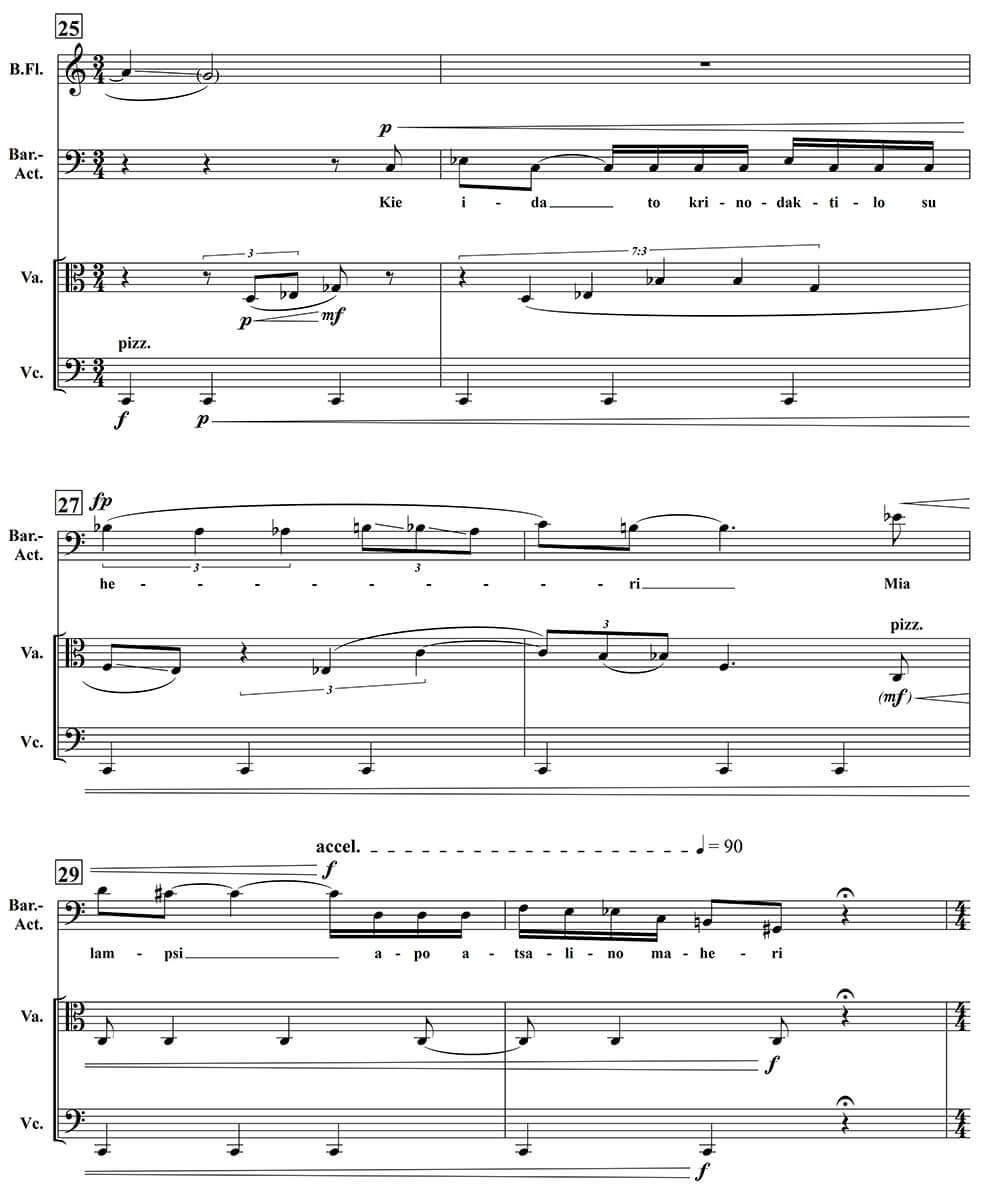
[6.6] A characteristic example occurs in mm. 23–30 of Kērēthres, where the voice delivers the lines k’ eida to krinodachtylo sou cheri / mia lampsē apo atsalino machairi (“and I saw your lily-fingered hand / a flash from a steel knife”). The contrary chromatic motion of the piano voices in m. 23 acquires clear rhythmic articulation and prepares the steady pulse subsequently established in the cello pizzicato. Against this rhythmically articulated drone, the viola initially moves in sparser rhythmic figures and subsequently in syncopated patterns, while the vocal line gradually becomes more active and, from m. 29 onward, accelerates under the indication accel. toward the phrase mia lampsē apo atsalino machairi (see Example 13). In Hasty’s sense of “projection,” this steady pulse functions as an active temporal point of reference for the unfolding of subsequent events. From this perspective, the narrative function of rhythm emerges from the temporal trajectory of the passage as a whole, extending from the chromatic motion and the gradual establishment of a rhythmic axis to the acceleration of the vocal delivery.
Example 13. Kērēthres, mm. 25–30: the recurrence of rhythmic figures in the strings as the basis for a field of temporal continuity, and the gradual acceleration of the vocal delivery toward mia lampsē apo atsalino machairi (“a flash from a steel knife”).
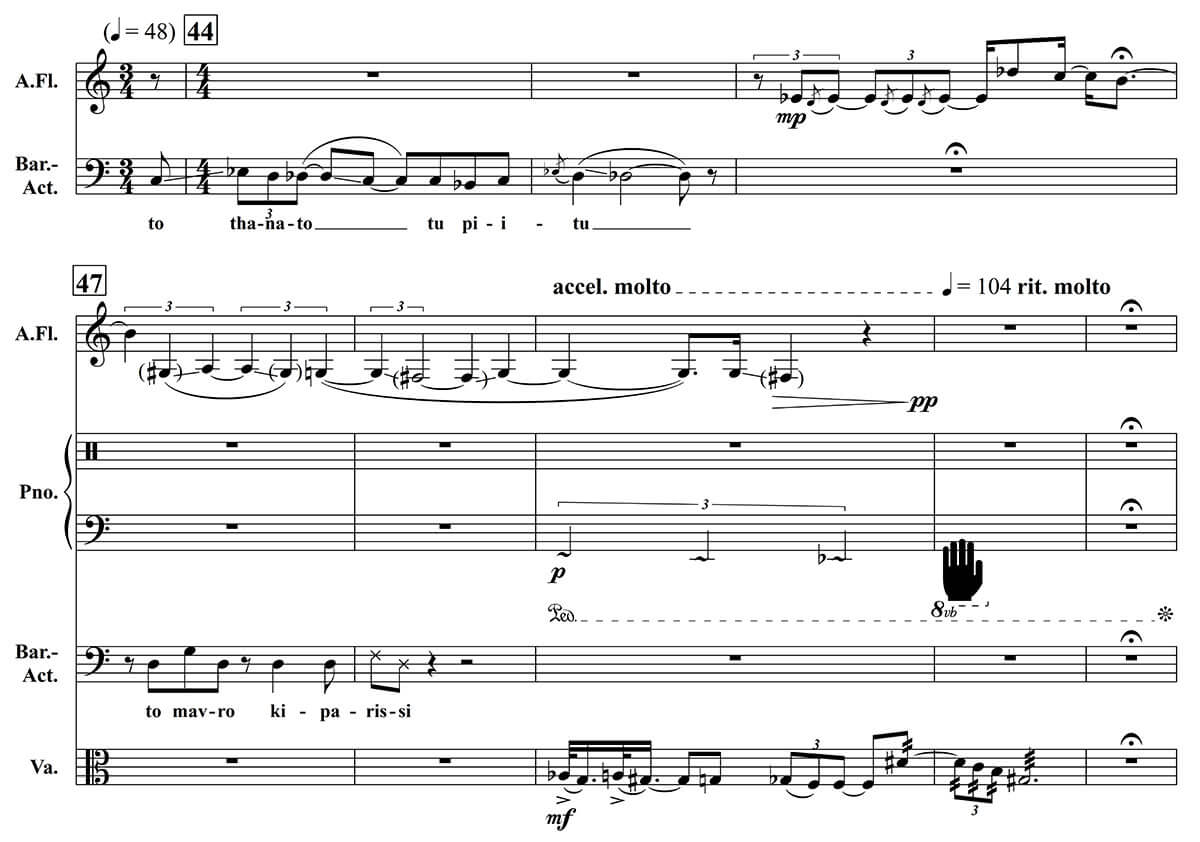
[6.7] A different manifestation of the narrative function of rhythm emerges in mm. 44–51. Following the completion of the phrase to thanato tou poiētou (“the poet’s death”), the alto flute takes over the musical line, while in mm. 47–48 the poetic text is delivered in a whisper. Under the indication accel. molto, the flute line increases in rhythmic density and, before reaching its conclusion, is overlapped by the entrance of the viola. The ensuing rit. molto interrupts the preceding acceleration and leads into a region of temporal suspension (see Example 8). The narrative function of rhythm thus emerges from the horizontal unfolding of the passage. As musical continuity is articulated successively by the voice and the instrumental lines (Example 14), the locus of narrative articulation can be understood more broadly, as arising from the interaction of its constituent vocal and instrumental components. In this sense, “narrative rhythm” gradually participates in the constitution of that narrative locus itself.[25]
Example 14. Theodore Antoniou, Kērēthres, mm. 44–51: narrative articulation through the successive transfer of musical continuity from the voice to the alto flute, rhythmic acceleration, and the overlapping entrance of the viola.
[6.8] In a later passage of the work, this horizontal dimension comes into sharper focus through the recurrence of the same rhythmic figure in different vocal contexts. In mm. 104–15, the pianist temporarily leaves the keyboard to play the daouli or bass drum, repeating a steady eighth-note–dotted-quarter-note figure, while the voice appears without poetic text, in the form of humming (see Example 9). In mm. 121–24, the same short–long rhythmic figure returns, this time in conjunction with the recitation of the poetic text Ta matia kleiō, argopethainō—to thanato tou poiētou! (“I close my eyes, slowly I am dying—the poet’s death!”) (see Example 15). Its narrative significance arises not simply from its coexistence with the voice in the two passages, but more importantly from its recurrence within the temporal unfolding of the work. The same rhythmic figure links humming with recitation, functioning as an element of continuity between these two modes of vocal presence. Further significance derives from the fact that this function is assigned to the pianist. In mm. 23–30, the chromatic motion of the piano had already acquired a rhythmic function, preparing the steady pulse in the cello, whereas in mm. 104–15 and 121–24 this function is detached from the pitched content of the keyboard and assumes a purely percussive form. This process may be understood as a further crystallization of a mode of rhythmic organization already established in mm. 23–30 and returning later in a different form.
Example 15. Theodore Antoniou, Kērēthres, mm. 121–24: recurrence of the short–long percussive rhythmic figure with poetic recitation, establishing continuity between contrasting modes of vocal presence.
[6.9] The use of the term “narrative” also requires careful theoretical delimitation. In the present context, narrative does not refer to an extramusical plot, nor is it reducible to a simple linear succession of eents. Rather, it refers to a temporal process apprehended as a trajectory. Paul Ricoeur associates narrative with the synthesis of heterogeneous elements within a temporal unity—that is, with the capacity of plot to “grasp together” individual events and, out of their multiplicity, constitute the unity of a temporal whole.[26] This idea may be extended, with due analytical caution, to Antoniou’s music: in Kērēthres, the voice, the poetic text, the drone-based planes, changes in timbre, and harmonic suspension are not presented as independent layers but are organized within a temporal process that the listener can follow as a coherent musical trajectory.
[6.10] The connection between the term “narrative rhythms” and the theater may be grounded in the distinctive relationship that ancient tragedy establishes among narrative, the staged presence of speech, and the temporal organization of action. In her examination of narrative technique in Aeschylus, Sophocles, and Euripides, Barbara Goward observes that narrative techniques derived from epic poetry find their way into tragedy and are reshaped within a genre in which narrative coexists with staged action, dialogue, and the chorus’s lyric voice. Narrative thus concerns both the recounting of events and the ways in which speech is temporally organized within the form of tragedy itself. Of particular significance for the present approach is the function of narrative time: through the chorus and its distinctive “lyric voice,” tragedy can reach into the past, hint at the future, and open up temporal perspectives beyond the immediate time of staged action.[27] On the basis of this discussion, Antoniou’s “narrative rhythms” are approached here in relation to these functions of speech in tragedy. The term describes rhythmic processes through which vocal delivery—with or without verbal content—is shaped in time: at times it remains rhythmically restrained, at others it accelerates, while elsewhere it is dispersed across successive vocal entries or condensed into homorhythmic articulation.
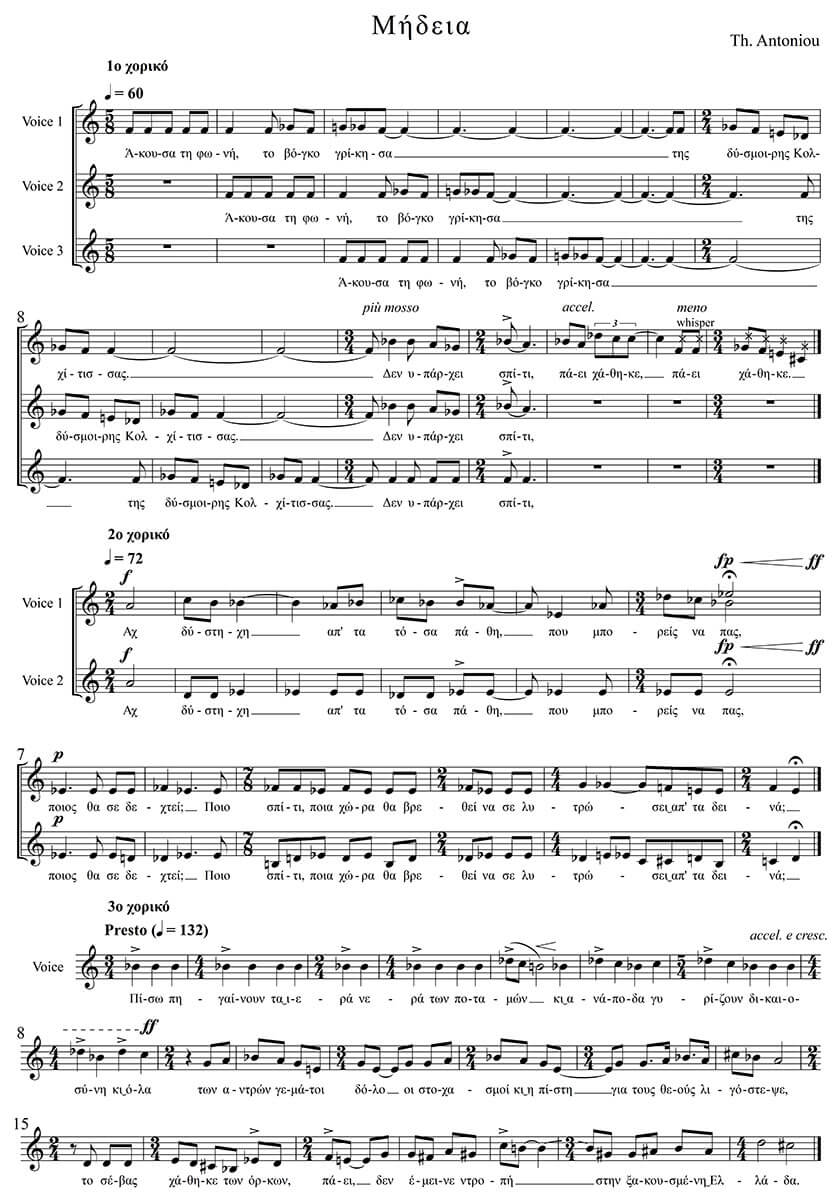
[6.11] To show how this practice operates in Antoniou’s music for the theater, this section considers three representative examples from the eight choral pieces he composed in 1976 for a stage production of Euripides’ Medea.[28] These examples reveal different ways in which rhythm is connected with vocal delivery and the staged presence of speech (see Example 16). In the first choral piece, the three-part writing is organized through successive, temporally displaced entries on the same phrase. From the outset, this procedure suggests the contrapuntal logic of canon or, more broadly, an imitative technique, as the first two phrases of the poetic text pass from one voice to another and the texture gradually becomes denser through the overlapping of the lines. This reading proceeds from the musical technique itself and shows how that technique acquires dramaturgical significance within the theatrical context. The temporal displacement of the entries and the delivery of the same phrase by different groups of the chorus create an initial process of textual diffusion, in which the phrase passes from voice to voice and gradually assumes a collective presence. The continuous changes of meter, the indications accel., più mosso, and meno, and the subsequent shift to differentiated modes of vocal delivery, including whisper, show that rhythm plays a decisive role in the way speech emerges, unfolds, and is transformed within stage time.
[6.12] In the second choral piece, the writing takes the form of a two-part homorhythmic setting of the poetic text. Changes of meter and dynamics heighten its dramatic intensity, while the rhythmic alignment of the two voices prepares the subsequent transition to the monophonic writing of the third choral piece. In this third piece, the single vocal line, through continuous metric changes, accents, and the indication accel. e cresc., concentrates the dramatic tension into a rapidly unfolding flow of speech. Taken together, the three examples reveal a gradation in the modes of vocal organization of the poetic text: development through three-part contrapuntal writing, compression into a two-part homorhythmic setting, and, finally, monophonic writing, in which the musical and verbal flow accelerates. By comparison with Le Jardin des Rochers, where the focus lies primarily on the gradual shaping of a single word within the choral writing, the choral pieces from Medea bring to the fore the theatrical activation of speech within the choral body.
[6.13] In light of the preceding discussion, Antoniou’s sketch (Example 11) may provide the basis for an initial categorization of these rhythmic figures. The whole note, successive quarter notes, and repeated shorter note values represented in the sketch may serve to establish either a static or a rhythmically regulated drone function. Their drone-based dimension, however, does not exhaust their significance. When these figures are connected with the vocal line, prosodic articulation, and the unfolding of poetic meaning, they assume an active role in shaping musical continuity. They may hold back the flow of time, create a temporal ground of expectation, reinforce verbal delivery, or function as a stable axis against the fluidity of the voice leading.
[6.14] In the second and fourth patterns of the handwritten note, the rhythmic organization appears to assume a more fluid character. The half-note triplets—with the whole note as their point of reference—and the quarter-note triplets—with two quarter notes as their point of reference—both articulate a 3:2 proportional relationship, corresponding to the hemiolios (sesquialter) ratio.[29] This proportional organization alters the sense of regular rhythmic flow, producing internal deviations, changes in rhythmic density, or local reorganizations of temporal articulation. In a vocal work, such proportional relationships can contribute to flexibility in vocal delivery, particularly when the voice moves between recitation, melodic unfolding, and differentiated vocal qualities such as humming or whispering.[30]
[6.15] The significance of the term “narrative rhythms” ultimately lies in its capacity to describe a distinctive mode of temporal articulation in Antoniou’s vocal and choral writing, as well as in his music for the theater. In Kērēthres, Le Jardin des Rochers, and the choral pieces from Medea, rhythm organizes different modes of vocal and verbal presence: it sustains the unfolding of an individual vocal line, shapes the gradual emergence of a word within the choral texture, and, in Antoniou’s music for the theater, governs the transition from contrapuntal diffusion to homorhythmic setting and ultimately to monophonic writing, with an increasingly accelerated musical and verbal flow. Understood in this sense, “narrative rhythms” illuminate a crucial aspect of Antoniou’s musical thought, as rhythm brings speech, voice, and form into relation within the unfolding of musical time.
Example 16. Theodore Antoniou, Medea (1976): different modes of rhythmic organization of vocal delivery in three choral pieces.[31]
7. Discussion and Conclusions
[7.1] The analysis has shown that the three analytical strands identified at the outset—ambiguous voice leading, “narrative rhythms,” and suspended harmony—operate as interrelated dimensions of the work’s musical organization. Ambiguous voice leading arises through melodic trajectories that project potential points of arrival while their cadential confirmation is continually deferred, displaced, or weakened. “Narrative rhythms” concern the temporal shaping of vocal and verbal presence. Rhythmic figures acquire narrative significance either through their direct association with the vocal line and the delivery of the poetic text or through their horizontal unfolding, as they are transformed, accelerated or decelerated, recur, and pass between vocal and instrumental lines. Suspended harmony, in turn, emerges from the interaction of transient tonal centers, modal and chromatic fields, heterogeneous pitch collections, and cadential expectations that remain unresolved or are only provisionally fulfilled. Together, these three processes shape a musical environment in which melodic direction, rhythmic articulation, and harmonic orientation remain in continual motion.
[7.2] The third of these analytical strands, suspended harmony, may be considered more broadly in relation to the selection, treatment, and directional shaping of the work’s pitch-rhythmic material and, in certain regions, to the timbral differentiation through which that material is articulated. The conception of a hovering sonic environment may be considered in relation to an earlier extramusical idea articulated elsewhere by the composer. In a lecture delivered at the Academy of Athens entitled “Setting Language to Music,” Antoniou refers to his Aphēgēseis (Narrations, 1996) for mezzo-soprano and orchestra, expressing the awe, reserve, and fear he experienced in approaching the poetry of Constantine Cavafy. In connection with the poem Phōnes (Voices) and his attempt to set it to music, he remarks, among other things:
It is a poem that leads us toward very contemporary approaches to composition and form. In setting it to music, I used a form known as the mobile, analogous to the moving three-dimensional sculptures (mobiles) of the renowned American sculptor and artist Alexander Calder (1898–1976). It is, therefore, a work of music in motion. I assigned different phrases to each instrument in the orchestra, corresponding to the voices of differing character described by the poet. (Antoniou 2016)
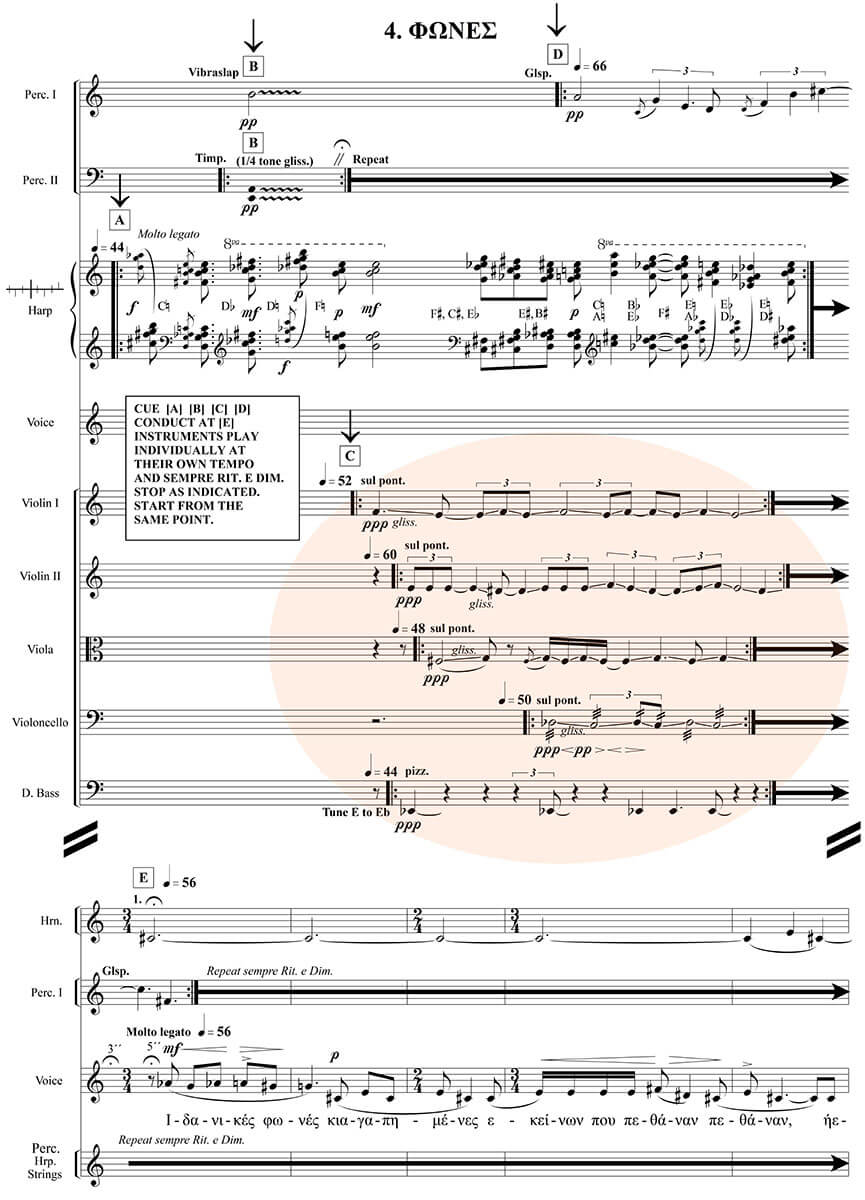
[7.3] In Calder’s sculptures, movement is not merely implied; it constitutes a defining principle of their very conception (see, for example, Calder 1948). The artist does not seek to imprison movement within materials that, by their very nature, are condemned to stagnation and immobility. Jean-Paul Sartre, writing evocatively about Calder’s sculptures, observes: “A Mobile: a small local festival, an object defined by its movement and nonexistent apart from it, a flower that withers as soon as it stops moving, a free play of movement, like coruscating light” (Sartre 1963, 78). Antoniou’s reflections on Cavafy’s poem Phōnes resonate with this conception of movement as essence: like Calder’s kinetic sculptures, his musical lines seem to exist only through movement. In Phōnes, this conception of “music in motion” is reflected in the superimposition of musical lines differing in melodic-rhythmic and expressive character, which contribute to a sense of rhythmic instability and generate a vibrant polyphony (see Example 17).
Example 17. Excerpt from Phōnes (Voices), the fourth movement of Aphēgēseis (Narrations) (1996) for mezzo-soprano and orchestra.[32]
[7.4] In Kērēthres, the idea of “music in motion” may be understood in relation to a melodic-rhythmic and harmonic ambiguity that takes shape in four principal ways: (a) through the polarity of denial–confirmation in the tonal clarity of a melodic succession, in light of the harmonic expectations established by its preparation; (b) through the heightened uncertainty generated by the sense of waiting at a hovering tonal center that seeks clarification; (c) through the intrusion of chromaticism into a diatonic texture or into a melodic unfolding harmonically supported by a rhythmically regulated drone; and (d) through proportional and artificial rhythmic accelerations and decelerations[33] occurring in close temporal proximity. Taken together, these elements contribute to a pulsating harmonic environment, creating the impression that the music is grounded more in a mutable pitch region than in a single stable tonal center. Closely related to the foregoing, it is also worth noting that chromaticism in the voice leading—at melodic endings, in phrase openings whose initial pitch is inconsistent with its preparatory context, and elsewhere—creates the sense of a sonic environment that seems to slip. Within this environment, the voice’s relationship to its initial pitch and to the direction of the line continually shifts, which also affects the delivery of the text. The score itself confirms that this tonal instability is compositionally determined rather than merely a feature of theatrical vocal performance.
[7.5] At a broader theoretical level, the idea of “music in motion” in Kērēthres may be considered in relation to questions of time, form, and the perception of temporal flow in contemporary music. The sense of melodic-rhythmic and harmonic instability extends beyond a surface condition to constitute a central aesthetic and compositional axis, one that resonates with Jonathan Kramer’s broader account of the relationship between linearity and nonlinearity and, more specifically, with what he terms nondirected linearity. In this temporal mode, music retains continuity and a sense of motion, while the goals of that motion are not unequivocally defined or predictable in advance (Kramer 1988, 39–40, 170–71, 182–83). In Kērēthres, the temporal continuum remains active, while its direction is continually redefined through the deferral or displacement of expected points of arrival. The recurrent displacement of tonal centers, the renewal of melodic direction, and the intrusion of modal and chromatic materials thus sustain a sense of progression without allowing a fully predictable orientation to become fixed.
[7.6] The twofold presentation of the poetic material, which Antoniou himself notes in the accompanying text,[34] is not organized as a standardized process of repetition. The “shorter” second presentation, as the composer describes it, is realized differently from passage to passage, as poetic material already heard returns selectively and under new musical or vocal conditions. In this sense, the second presentation constitutes a new musical reading of the poetic material. This process acquires particular significance in relation to Antoniou’s reservation about the possibility of conveying the imagination, meaning, and atmosphere of Varnalis’s poetry.[35] Although no direct causal relationship can be inferred between this statement and the twofold presentation, the return of the same poetic material under different musical and vocal conditions may nevertheless be understood as entirely consistent with that reservation.
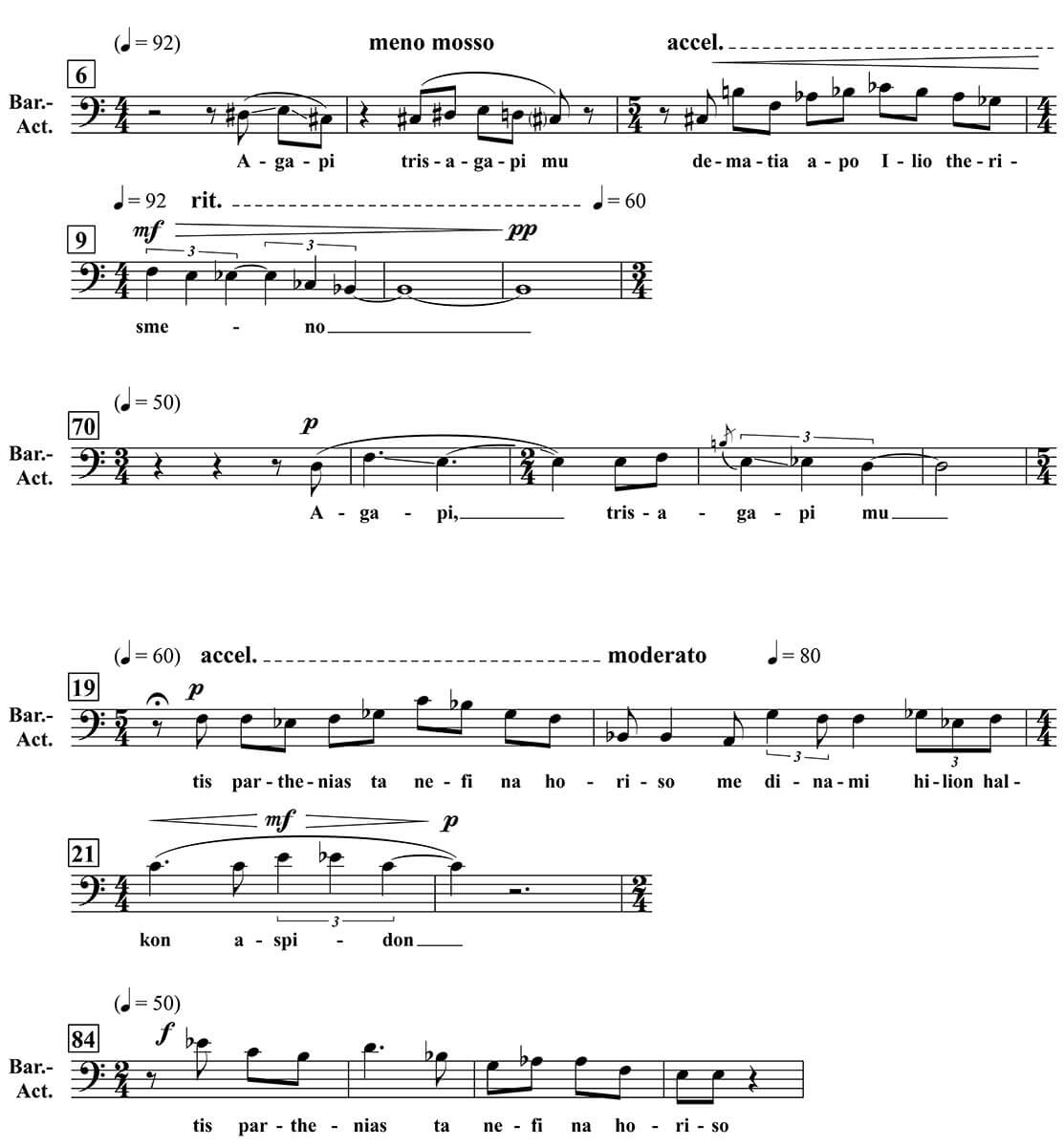
[7.7] Luciano Berio has described music as an “instrument for analysing the text,” emphasizing its capacity to “filter” a text by allowing certain elements to assume a dominant role while consigning others to the background (Berio 1989, 2). In Kērēthres, this idea acquires particular significance in relation to the selective return of the poetic material: its renewed presentation establishes a new hierarchy of listening and understanding, as the selection of the material that returns is combined with its musical reconception. Particularly revealing in this respect is the resetting of the phrases Agapē, trisagapē mou (“Love, my thrice-beloved”) and tēs parthenias ta nephē na chōrisō (“to part the clouds of virginity”) (Example 18). Now detached from their immediate poetic contexts, these phrases acquire greater autonomy and emerge as semantic and expressive focal points. Their isolation heightens their abstraction, facilitating the recall of meanings already established within the work and activating broader networks of association beyond their immediate semantic function in the original poem.
[7.8] The selective return and musical reconception of previously heard material also raise a broader question concerning the perception of form in time, one that may be related to David Lewin’s phenomenological approach to musical perception. Lewin takes the Husserlian distinction between the retention of the past in present consciousness and the anticipation of what is to come as a point of departure, but develops a more active account of perception in which the particular musical context plays a determining role. In his model, the perceptual significance of a musical event depends on the context in which it is apprehended and may shift as its relations to earlier and subsequent perceptions are reconfigured (Lewin 1986, 332–42, esp. 335–42).
[7.9] In this sense, the return of poetic material in Kērēthres under different musical and vocal conditions functions not merely as recollection. Each reappearance actively reconstitutes what has already been heard, as the new musical context modifies both the retrospective understanding of the material and the expectations it generates for what follows. The form may thus be understood as an unfolding trajectory in which the relations among what has already been heard, what is heard in the present, and what is anticipated are continually redefined in the course of listening. Particularly significant here is Theodore Antoniou’s remark, “Look at how the form proceeds, how it moves.”[36] At the compositional level, this observation further supports an understanding of form as emerging through continuous changes in musical organization, temporal articulation, and dramaturgical development.
Example 18. Theodore Antoniou, Kērēthres: selective return and resetting of the phrases Agapē, trisagapē mou (“Love, my thrice-beloved”) (mm. 6 and 70) and tēs parthenias ta nephē na chōrisō (“to part the clouds of virginity”) (mm. 19 and 84).
[7.10] The seemingly paradoxical idea that form itself “proceeds” and “moves” can be articulated with greater theoretical precision through the conception of form as process (processual form). Janet Schmalfeldt’s concept of becoming offers a specific model of such a process: as a work unfolds, the formal function initially suggested by a musical idea, phrase, or section may be retrospectively reinterpreted within the larger formal context. Form thus emerges through a dynamic interplay between recognizable formal conventions and the transformations those conventions undergo in the course of the work. Antoniou’s remark, however, appears to resonate even more closely with Theodor W. Adorno’s concept of musique informelle. In Adorno’s conception, informal music relinquishes external or abstract forms and organizational systems laid down in advance or superimposed upon the work, while its coherence is constituted within the musical substance itself. Such freedom is not equivalent to the absence of organization: rather, its organizing principles arise immanently from the work itself, without submission to an externally imposed formal norm.[37]
[7.11] This perspective complements the preceding phenomenological reading by shifting attention from the way in which the perception of form is reshaped in the course of listening to the role played by transformations of the musical material itself in the constitution of form. In Kērēthres, continual shifts in melodic direction, rhythmic and harmonic fluidity, changes in timbre, and the different modes of vocal delivery of the poetic text participate directly in this process as the work unfolds. In this sense, Antoniou’s use of the verbs “proceeds” and “moves” may be read as a concise expression of a processual conception of form, in which the work’s coherence emerges through the continuity and transformation of the musical relations themselves.
[7.12] Tonal references and a fluctuating sense of tonal centricity are readily discernible features of Theodore Antoniou’s Kērēthres. This sense of centricity may be understood as arising from the structural organization of the melodic lines and their interaction with the harmonic and pitch environment within which they unfold. In an interview published in the journal of the Greek Composers’ Union, Antoniou remarked:
I believe I have never lost touch with certain characteristics of music, such as its tonal and melodic elements; I simply try to find them by taking different paths. (Antoniou 2006, 34)
[7.13] A similar orientation is also evident in Antoniou’s attempt to define music in an interview broadcast on the Third Programme of the Hellenic Broadcasting Corporation (ERT):
I would say that “music” is, unquestionably, something expressed through sounds, and it would be desirable for these sounds to express something far beyond the isolated sound we hear. Moreover, it would be desirable for these sounds to be both unfamiliar and familiar to us at the same time, to be natural and yet unknown. (Antoniou 1993)
[7.14] Against this background, Kērēthres may be regarded as a characteristic expression of Antoniou’s sustained exploration of the possibilities of pitch organization. The work articulates a musical language that assimilates contemporary idioms while maintaining an active connection with tonal and melodic elements. The continual motion and transformation of the pitch material, together with melodic ambiguity, are integrated into a coherent compositional strategy through which a distinctive internal logic takes shape over time. Considered together, ambiguous voice leading, “narrative rhythms,” and suspended harmony function as mutually reinforcing processes. Melodic direction continually renews and redirects expectations; rhythmic organization shapes the temporal and vocal articulation of the poetic text, while harmonic fields sustain a sense of orientation without allowing it to become fixed. Their interaction contributes directly to the coherence of form as process, as dramaturgical development and continually changing musical relations give rise to an organically structured musical trajectory.
Works Cited
Adorno, Theodor W. 1998. Quasi una Fantasia: Essays on Modern Music. Translated by Rodney Livingstone. London and New York: Verso.
Alexiadis, Minas. 1986. “Werkanalyse über Nenikēkamen von Theodore Antoniou.” Diplomarbeit, Staatliche Hochschule für Musik Rheinland, Robert Schumann-Institut Düsseldorf.
Andronikou, Michalis, and Friedemann Sallis. 2012. “Centring the Periphery: Local Identity in the Music of Theodore Antoniou and Other Twentieth-Century Greek Composers.” Intersections 33 (1): 11–34. https://doi.org/10.7202/1025553ar.
Antoniou, Theodore. 1976. Medea. Handwritten score. Copy supplied by the composer to the author.
———. 1982. “Η ελληνική μουσική στο θέατρο” [Greek music in the theater]. Interview by Thesia Panayiotou. Radio broadcast, ERT (Hellenic Broadcasting Corporation), 27 October. Recording preserved in the ERT Archive.
———. 1987. “Η μουσική στο θέατρο” [Music in the theater]. Paper presented at the Μουσικές Εβδομάδες Βέροιας [Musical Weeks of Veria], 13 May. Recording preserved in the ERT Archive.
———. 1993. “Τελετές Προετοιμασίας” [Rites of preparation]. Interview by Michalis Mitras. Radio broadcast, Τρίτο Πρόγραμμα [Third Programme], ERT (Hellenic Broadcasting Corporation), 7 June. Recording preserved in the ERT Archive.
———. 1996. Aphēgēseis (Narrations). Score for mezzo-soprano and orchestra. Finale and PDF files provided directly to the author by the composer. Unpublished manuscript.
———. 2005. “Θόδωρος Αντωνίου: Γράφοντας μουσική για το αρχαίο δράμα” [Theodore Antoniou: Writing music for ancient drama]. Edited and transcribed by Konstantinos A. Lygnos. Antiphōnon 11 (July–August): 32–37.
———. 2006. “Θόδωρος Αντωνίου: ‘επί προσωπικού’” [Theodore Antoniou: “On a personal note”]. Interview by Konstantinos A. Lygnos and Maria Ch. Krithara. Μουσικής Πολύτονον 16 (May–June): 32–36.
———. 2008. Kērēthres [Honeycombs]. Score supplied by the composer to the author. Copy in the author’s possession.
———. 2009. Accompanying note to Κώστας Βάρναλης: «…στα ηχοκύματα υψωμένοι» / Kostas Varnalis: “…rising on soundwaves,” 25–26. CD booklet. Nea Aghialos Society of Athens “I Aghialos” [Σύλλογος των Αγχιαλιτών της Αθήνας «Η Αγχίαλος»].
———. 2014a. Κατάλογος έργων / Work Catalogue. Athens: Philippos Nakas.
———. 2014b. “Program Notes.” In Friendly Encounters: Solo and Chamber Music around the Flute. Unpaginated accompanying booklet to 2-CD/1-DVD set. Nea Aghialos Society of Athens “I Aghialos” [Σύλλογος των Αγχιαλιτών της Αθήνας «Η Αγχίαλος»].
———. 2016. “Μελοποίηση της Γλώσσας” [Setting language to music]. Lecture delivered at the Academy of Athens, February. Unpublished manuscript. Theodore Antoniou Archive.
Bartók, Béla. 1976. Béla Bartók Essays. Edited by Benjamin Suchoff. New York: St. Martin’s Press.
Berio, Luciano. 1989. “Eco in ascolto.” Interview by Umberto Eco. Translated by David Osmond-Smith. Contemporary Music Review 5 (1): 1–8.
Calder, Alexander. 1948. Dispersed Objects with Brass Gong. Hanging mobile. Calder Foundation. https://calder.org/works/hanging-mobile/dispersed-objects-with-brass-gong-1948/.
Chardali, Rodopi. 2012. “Θόδωρος Αντωνίου (1935–): Βίος, εργογραφία και συνθετικό ύφος. Μία αναλυτική προσέγγιση μέσα από το έργο Nenikēkamen (1971) για αφηγητή, βαρύτονο, μέτζο σοπράνο, χορωδία και ορχήστρα” [Theodore Antoniou (1935–): Life, Oeuvre, and Compositional Style: An Analytical Approach through Nenikēkamen (1971) for Narrator, Baritone, Mezzo-Soprano, Chorus, and Orchestra]. Diploma thesis, Aristotle University of Thessaloniki.
Cohn, Richard. 2012. Audacious Euphony: Chromaticism and the Triad’s Second Nature. New York: Oxford University Press.
Cone, Edward T. 1974. The Composer’s Voice. Berkeley: University of California Press.
Cooper, Grosvenor, and Leonard B. Meyer. 1960. The Rhythmic Structure of Music. Chicago: University of Chicago Press.
Destounis, Konstantinos. 2019. “The Solo Piano Works of Theodore Antoniou in the Context of Contemporary Greek Piano Repertoire: A Performer’s Approach.” DMus thesis, Royal College of Music.
Gao, Yiyi. 2021. “Nontraditional Six-Four Chords and Their Impact on Middleground Structures in Schumann, Brahms, and Saint-Saëns.” PhD diss., University of North Texas.
Goward, Barbara. 1999. Telling Tragedy: Narrative Technique in Aeschylus, Sophocles and Euripides. London: Duckworth.
Gratsouna, Athina. 2020. “Το βιολί στον 20ο και 21ο αιώνα: Ζητήματα αισθητικής, εκτέλεσης και τεχνικής προσέγγισης στο έργο του Θεόδωρου Αντωνίου «24 Caprices for Violin Solo»” [The Violin in the Twentieth and Twenty-First Centuries: Questions of Aesthetics, Performance, and Technical Approach in Theodore Antoniou’s 24 Caprices for Violin Solo]. Master’s thesis (academic year 2019–2020), National and Kapodistrian University of Athens.
Hasty, Christopher F. 1997. Meter as Rhythm. New York: Oxford University Press.
Hatten, Robert S. 2018. A Theory of Virtual Agency for Western Art Music. Bloomington: Indiana University Press.
Hewitt, Michael. 2013. Musical Scales of the World. London: The Note Tree.
Huron, David. 2016. Voice Leading: The Science behind a Musical Art. Cambridge, MA: MIT Press.
Jakubowski, Joseph R. 2020. “Embodied Form in Grisey’s Prologue: Variation, Opposition, Tension.” Intégral 34: 1–23.
Karathodoros, Theodore. 2015. “Theodore Antoniou: Friendly Encounters, Solo and Chamber Music around the Flute.” Unpublished lecture delivered at the Friends of Music Society’s Polychōros [Multipurpose Hall], Megaron – The Athens Concert Hall, 16 January, on the occasion of the presentation of the eponymous 2-CD/1-DVD release.
Kozak, Mariusz. 2020. Enacting Musical Time: The Bodily Experience of New Music. New York: Oxford University Press.
Kramer, Jonathan D. 1988. The Time of Music: New Meanings, New Temporalities, New Listening Strategies. New York: Schirmer Books.
Lehmann, Hans-Thies. 2006. Postdramatic Theatre. Translated by Karen Jürs-Munby. New York and London: Routledge.
Lewin, David. 1986. “Music Theory, Phenomenology, and Modes of Perception.” Music Perception 3 (4): 327–92.
Loya, Shay. 2011. Liszt’s Transcultural Modernism and the Hungarian-Gypsy Tradition. Rochester, NY: University of Rochester Press.
Persichetti, Vincent. 1961. Twentieth-Century Harmony: Creative Aspects and Practice. New York: W. W. Norton & Company.
Ricoeur, Paul. 1984. Time and Narrative. Vol. 1. Translated by Kathleen McLaughlin and David Pellauer. Chicago: University of Chicago Press.
Roesner, David. 2014. Musicality in Theatre: Music as Model, Method and Metaphor in Theatre-Making. Farnham: Ashgate.
Samara, Sophia. 2016. “Όπερα και μουσικό θέατρο στα έργα του Θόδωρου Αντωνίου” [Opera and Music Theater in the Works of Theodore Antoniou]. PhD diss., National and Kapodistrian University of Athens.
Sartre, Jean-Paul. 1963. “The Mobiles of Calder.” In Essays in Aesthetics, selected and translated by Wade Baskin, 78–81. New York: Philosophical Library.
Schmalfeldt, Janet. 2011. In the Process of Becoming: Analytic and Philosophical Perspectives on Form in Early Nineteenth-Century Music. New York: Oxford University Press.
Schoenberg, Arnold. 1978. Theory of Harmony. Translated by Roy E. Carter. Berkeley and Los Angeles: University of California Press.
Schuijer, Michiel. 2008. Analyzing Atonal Music: Pitch-Class Set Theory and Its Contexts. Rochester, NY: University of Rochester Press.
Slobin, Mark, ed. 1982. Old Jewish Folk Music: The Collections and Writings of Moshe Beregovski. Philadelphia: University of Pennsylvania Press.
Stefanides, Vasileios. (1819) 1997. Theōrētikon [Θεωρητικόν]. Edited by Charalampos Karakatsanis. Hē Kat’ Anatolas Pylē [Η Κατ’ Ανατολάς Πύλη] (Byzantinē Potamēis, vol. VI). Athens. First published Neochōri on the Bosporus, 1819.
Straus, Joseph N. 2016. Introduction to Post-Tonal Theory. 4th ed. New York and London: W. W. Norton & Company.
Susanni, Paolo, and Elliott Antokoletz. 2012. Music and Twentieth-Century Tonality: Harmonic Progression Based on Modality and the Interval Cycles. New York and London: Routledge.
Τιμητική Βραδιά–Συναυλία για τον Θόδωρο Αντωνίου, για την εκλογή του ως Μέλος της Ακαδημίας Αθηνών [Tribute Evening–Concert for Theodore Antoniou, on His Election as a Member of the Academy of Athens]. 2015. Concert program. Heraklion: Ωδείο των Χρωμάτων [Conservatory of Colors], 4 April.
Varnalis, Kostas. 1985. Kērēthres [Honeycombs]. Edited by K. G. Kasinis. Athens: Kedros.
Venegas Carro, Gabriel I. 2020. “Schubert’s Experiments with Processual Form.” Musica Theorica 5 (2): 259–78.
Williams, C. F. Abdy. (1911) 2009. The Aristoxenian Theory of Musical Rhythm. Cambridge: Cambridge University Press.
Discography
Antoniou, Theodore. 2014. Friendly Encounters: Solo and Chamber Music around the Flute. 2-CD/1-DVD set. Nea Aghialos Society of Athens “I Aghialos” [Σύλλογος των Αγχιαλιτών της Αθήνας «Η Αγχίαλος»].
Κώστας Βάρναλης: «…στα ηχοκύματα υψωμένοι» / Kostas Varnalis: “…rising on soundwaves.” 2009. CD. Nea Aghialos Society of Athens “I Aghialos” [Σύλλογος των Αγχιαλιτών της Αθήνας «Η Αγχίαλος»].
Notes
[1] The program includes statements on Antoniou by Leonard Bernstein, Darius Milhaud, George Crumb, Lukas Foss, Ernst Krenek, and Aaron Copland, together with archival photographic material documenting aspects of his international musical activity.
[2] On the matter of the theater’s influence on Antoniou’s compositional output, the composer himself stated: “There is always a hidden plot behind the music I compose; no matter if it is for piano solo or any other combination of instruments, theater is always in my head. Whenever I compose, I have in mind something of a dramatic nature” (Destounis 2019, 40). Similarly, in a text derived from a lecture by Antoniou and published in the journal of the Greek Composers’ Union, he observed: “In taking stock of my own work for the theater, I would begin in the mid-1960s, when I first wrote music for tragedy. At that time, my approach to writing for the theater was almost the same as my approach to ‘absolute music,’ that is, music written outside the theater” (Antoniou 2005, 35).
[3] In this broadcast, the composer discusses his music for Euripides’ Βάκχες (Bacchae), including the original score for the Broadway production directed by Michalis Cacoyannis and the new score composed for the Comédie-Française production in Paris on 14 April 1976. The broadcast includes the introduction to the earlier score, as well as the new music composed for the same tragedy for the Paris production.
[4] The points of convergence between the music Antoniou composed for Euripides’ Bacchae and his later works lie in the use of tetrachords, the emphasis on particular intervals and melodic contours, the chromatic and diatonic character of the melodic lines, and, of course, the recurrence of common rhythmic patterns.
[5] The event, part of the Μουσικές Εβδομάδες Βέροιας [Musical Weeks of Veria], was devoted to musical creation for the theater and included contributions by Theodore Antoniou, Nikiforos Rotas, Odysseas Goniadis, and Giorgos Tsangaris.
[6] The incorporation of an abstract extramusical idea into the four established musical parameters—pitch, duration, timbre, and dynamics—and the dominant role it assumes in the organization of the musical material arguably encapsulate the quintessence of Antoniou’s compositional thought. By analogy, the conception of the abstract extramusical idea as an additional fifth parameter may recall Aristotle’s distinction between the four terrestrial elements and the fifth, celestial element, aether.
[7] In the prerecorded material, Kostas Varnalis himself can be heard reciting lines from the poems “Ο Οδηγητής” [“The Guide”] and “Οι Μοιραίοι” [“The Doomed”], which belong, respectively, to the poetry collections Το φως που καίει [The Light That Burns] and Ποιητικά [Poetic Works]. Antoniou’s voice is also interspersed within the same recorded material, reading lines from the poetic excerpts he selected for the composition. The English translations of the titles are mine.
[8] The recording of Kērēthres features Tasos Apostolou, bass-baritone/narrator; Iwona Glinka, alto and bass flutes; Vicky Stylianou, piano; Ilias Sdoukos, viola; and Kostis Theos, cello, conducted by Theodore Antoniou.
[9] The recording project was also accompanied by a concert featuring the works included on the CD, held at Megaron – The Athens Concert Hall in March 2009. The event was organized by the same institution that released the CD, the Nea Aghialos Society of Athens “I Aghialos” [Σύλλογος των Αγχιαλιτών της Αθήνας «Η Αγχίαλος»].
[10] The term “tonal centricity” is used here not in the sense of the functional tonality of the major–minor system as consolidated during the common-practice period, but to denote the local or ambiguous emergence of tonal centers within modal, chromatic, or mixed pitch environments. For terminological consistency, tonal center designates a pitch that serves as an organizing point of reference within a given passage, while tonal centricity refers to the broader phenomenon of such orientation. Pitch focalization, in turn, denotes the temporary prominence of a particular pitch, which does not necessarily establish it as the prevailing center. Paolo Susanni and Elliott Antokoletz observe that, in twentieth-century musical idioms, once pitch relations are no longer grounded in a functional tonal hierarchy, it is no longer appropriate to speak of key in its traditional sense; the terms tonal center and tonal centricity are more apt. They further note that, where tonal centricity is ambiguous, a tonal center may be asserted through the repetition of a single pitch or chord; through its placement in a prominent registral or metric position; through the use of ostinato chords or pedal points; or through its appearance at significant formal junctures (Susanni and Antokoletz 2012, 11–13).
[11] For a discussion of the limitations of applying pitch-class set theory to musical languages based on modes, scales, or hybrid modal formations, see Susanni and Antokoletz (2012, xi–xiii). The authors maintain that pitch-class set theory may be applicable to the analysis of atonal idioms, as in the case of Schoenberg, but does not always adequately account for music whose pitch organization is shaped by modes, scales, and hybrid modal formations. For Susanni and Antokoletz, the issue lies not only in identifying the pitches that constitute a collection, but also in understanding how pitch relations generate tonal centricity, harmonic progression, and formal function. Michiel Schuijer, for his part, addresses two critical methodological issues in pitch-class set theory: first, the problem of segmentation—that is, the criteria by which the analyst determines which pitches constitute a set—and, second, the question of aural perception, since a pitch-class set is not necessarily perceived as a unified structural whole, nor do all of its members function with equal weight within a given musical context (Schuijer 2008, 23–24, 130–31). These considerations are particularly important for the present analysis, since in Kērēthres pitches acquire significance not primarily through their membership in abstract sets, but through their temporary prominence, their roles as points of attraction or deviation, and their participation in cadential gestures within a modally and chromatically unstable environment.
[12] David Huron succinctly defines voice leading as “the art of combining concurrent musical lines or melodies.” He treats part-writing as a narrower practice encompassed within voice leading, while relating the broader concept to the perceptual conditions through which listeners organize distinct yet simultaneous musical lines. Particularly important for the present analysis is his view that voice leading concerns not only the preservation of the perceptual independence of individual voices, but also listeners’ expectations regarding how sounds move, tend, or are directed toward a destination. From a different theoretical point of departure, Richard Cohn examines nineteenth-century chromatic harmony through relations among major and minor triads, which are organized in chromatic space by voice-leading relations based on minimal motion and interact with the diatonic and functional logic of common-practice tonality. The concept of ambiguity assumes a more specific analytical function in Yiyi Gao’s dissertation, where certain six-four chords are treated as functionally ambiguous because their voice-leading and metric configuration permits more than one harmonic or structural reading. The present analysis does not adopt any of these models in its entirety; rather, it draws on their broader theoretical contributions in defining “ambiguous voice leading” as a process in which melodic directionality, chromatic attractions, modal references, and cadential gestures generate expectations of pitch-directed motion that are subsequently deferred, displaced, or destabilized (Huron 2016, 1–6, 129–47; Cohn 2012, 195–208; Gao 2021, 1–2, 97–99).
[13] The connection drawn here between paratactic form and dramaturgical organization is based on analogy and is not intended to identify Kērēthres with postdramatic theater. Hans-Thies Lehmann describes paratactic or non-hierarchical organization as a mode of employing and arranging theatrical means in which language, sound, movement, the body, and stage space are not necessarily subordinated to a single, unambiguous hierarchy, but may retain their own forces within the overall field of performance. Within the same framework, the “musicalization” of theatrical means allows the sonic and rhythmic dimensions to assume an organizational role (Lehmann 2006, 85–93). On musicality as an analytical framework that directs attention to the sonic and rhythmic qualities of theatrical practice and to the ways in which they contribute to the formation of scenic form, see Roesner (2014, 12–15, 257–59).
[14] This technique appears to reverse the practice of kanonarchēma in Byzantine chant, in which the kanonarchēs (precentor) first recites the poetic text before it is chanted.
[15] On the leading-tone relationships generated by chromatic voice leading in the context of secondary dominants, Schoenberg (1978, 185) observes: “After the pupil has first used secondary dominants without chromatic movement, keeping as it were to the diatonic patterns of minor, he can then go on to produce them through chromatic progression. Then the possibilities for using them are greatly increased. Here the following is to be observed: the reason for raising [or lowering] a tone chromatically is to get a leading tone, upward or downward.”
[16] Within the expanded tonal framework centered on C, the chord in question may be interpreted as IV/N. One of the subjects most frequently discussed by Antoniou and the present author concerned the interpretation and harmonic function of major and minor chords built on the chromatically altered degrees of a scale. Indeed, while serving on conservatory examination committees, Antoniou would often ask how the G♭-minor chord might be interpreted within the key of C major. The answer to this question—iv/N—broadens the discussion of the use of the G♭-major chord in m. 18 of the work and of the harmonic suspension produced by the manner in which it is employed.
[17] A term used by the composer in reference to specific rhythmic formations. Such formations are not confined to vocal music; their narrative function, however, emerges primarily in relation to the vocal line and the delivery of the text. The term is examined in greater detail below.
[18] The term “chromatic compression” is used by Béla Bartók to describe the contraction of a diatonic melody when it is condensed through chromatic adjacency between pitches. Bartók characterizes this process as the compression of diatonic melodies into a chromatic level, observing: “The chromatic melodies […], as a matter of fact, [are] nothing else than diatonic melodies of the neighbouring areas, compressed into a chromatic level” (Bartók 1976, 382).
[19] The scale is also referred to as “Mela Hemavati” (Hewitt 2013, 317).
[20] Here, Hungarian minor denotes the collection C–D–E♭–F♯–G–A♭–B, also referred to as Gypsy minor. This collection should be distinguished from the double harmonic scale on C (C–D♭–E–F–G–A♭–B). The passage draws on selected pitch inflections associated with the Hungarian minor collection rather than presenting the scale in its entirety. For the relevant terminology and classification, see Loya (2011, 9, 52, 54 [table 1.2], 255n26).
[21] The distinction between functional tonality and the establishment of certain pitches as centric tones in post-tonal music may be grounded in Straus’s approach, according to which, in the absence of traditional harmonic functions and the voice leading associated with them, it is more accurate to speak of “centric tones” and “centricity” rather than of “tonics” and “tonality” in their traditional senses. In the same chapter, entitled “Centricity and Referential Pitch Collections,” Straus discusses referential pitch collections, including the diatonic, octatonic, whole-tone, and hexatonic collections. Particularly useful for the present analysis is his observation that, despite its symmetrical construction, the octatonic collection can contain familiar chordal formations, including major and minor triads, as well as minor, half-diminished, and dominant seventh chords (Straus 2016, 228–29, 249–52, 260).
[22] This account is based on the present author’s direct involvement in the recording project and on discussions with Antoniou concerning the realization of the work.
[23] On 13 June 2013, a concert featuring choral works and chamber-music compositions by Greek composers was held at the Music School of Lamia. Commissioned by the present author, Antoniou composed Le Jardin des Rochers for four-part women’s choir and piano. The work was performed by “Idiorrythmia,” the school’s equal-voice vocal ensemble, under the direction of the present author. Antoniou attended both the rehearsals and the concert. Also present were Michael Adamis, Athanasios Zervas, Dimitris Themelis, and Dinos Constantinides, whose works were included in the program. The occasion provided a particularly fruitful context for discussing “narrative rhythms” in Antoniou’s music.
[24] In Chapter 7, Hasty introduces the concept of “projection” within his conception of meter as a process of projection (meter as projection), while also employing the terms projective potential and projected potential and, in his subsequent elaboration of the theory, projective situation. In his definition, projection designates the entire process in which a completed duration functions as projective in relation to the potential duration of the immediately succeeding event, which is projected. Hasty further clarifies that projective potential does not refer to the expectation that a succeeding event will occur; rather, it concerns the capacity of a past and completed duration to remain relevant to the temporal becoming of a present event. Projection, moreover, is not confined to the measure, nor does it require a homogeneous train of pulses, and may operate at different levels of temporal organization (Hasty 1997, 84–91, 149).
[25] This reading is informed by Edward T. Cone’s distinction among the vocal persona, the instrumental persona, and the complete musical persona. For Cone, the last is inferred from the interaction of the other two, while the composer’s voice is heard “in a progression that synthesizes voice with accompaniment.” Robert S. Hatten, from a different theoretical perspective, argues that the temporal continuity of a musical line can support continuity “as a series of actions by a singular source”—and hence the continuity of the virtual agent it presupposes—while the musical texture as a whole may acquire an “integrative agential character” (Cone 1974, 16–18; Hatten 2018, 21).
[26] Ricoeur describes plot as a “synthesis of the heterogeneous,” whereby goals, causes, and chance are brought together within the temporal unity of a whole and complete action. Elsewhere, he characterizes the configurational function of plot as an operation that “grasps together” and integrates multiple and scattered events into a whole and complete story. This configurational operation is bound up with the narrative’s “capacity to be followed” by the reader or listener (Ricoeur 1984, ix–x, 66–67, 76).
[27] Goward examines the applicability of narrative theory to ancient tragedy, placing particular emphasis on the relationship between narrative and action and on the distinction between telling and showing. She observes that narrative techniques derived from epic poetry “find their way into tragedy” and are adapted through their transformation into the different medium of drama. Particularly relevant to the present approach is her discussion of narrative time in tragedy and of the function of the chorus, whose lyric voice has a “natural reach into the past and future,” allowing tragedy to evoke the past, hint at the future, and extend its temporal range beyond the immediate time of staged action (Goward 1999, 1–2, 9–15, 21–24).
[28] Theodore Antoniou’s Work Catalogue lists Medea by Euripides under “Music for theatre, cinema & TV,” with its premiere in Thessaloniki on 2 August 1976 (Antoniou 2014a, 31). The handwritten score (Antoniou 1976) supplied by the composer to the present author preserves pieces nos. 1, 2, 3, 5, 6, 7, and 8; no. 4 is absent from the surviving copy. The reference here to eight choral pieces follows the manuscript’s final numbering.
[29] «Ὅταν ἕνας ἀριθμὸς περιέχῃ ὁλόκληρον τὸν ἄλλον καὶ μέρος αὐτοῦ. Ὁ ἀριθμὸς 3 π.χ. περιέχῃ τὸν 2 μίαν φορὰν καὶ ἡμίσειαν. Ἡ σχέσις αὕτη, ἤτοι ὁ λόγος τῶν δύο ἀριθμῶν 3:2 (λόγος δὲ σημαίνει σύγκρισις, διαίρεσις) λέγεται καὶ ἡμιόλιος, διότι ὁ ἀριθμός 3 περιέχει τὸ ὅλον τοῦ 2 καὶ τὸ ἥμισυ αὐτοῦ, ἤτοι 3 = 2 + 1.» [English translation mine:] “When one number contains the other in its entirety and a part of it. For example, the number 3 contains 2 one and a half times. This relationship—that is, the ratio of the two numbers, 3:2 (for logos denotes comparison, division)—is also called hemiolios (sesquialter), because the number 3 contains the whole of 2 and half of it, that is, 3 = 2 + 1.” (Stefanides [1819] 1997, chap. III, “Peri symphōnias,” 4, §18)
[30] C. F. Abdy Williams ([1911] 2009, 24, 26–27) presents Aristoxenus’s distinction between rhythm and the rhythmizomenon as a distinction between “two different natures,” analogous to the relationship of a plan to the object that is planned. The rhythmizomenon is understood as the material subjected to rhythm—that is, melody or, more broadly, music; speech or poetry; and bodily movement or dance. The rhythmopoeia is defined as the art of applying rhythm to the rhythmizomenon and concerns both the construction of the individual measures and that of the complete phrase. This Aristoxenian conception is invoked here in a supplementary capacity, since it helps to define more precisely the relationship between Antoniou’s “narrative rhythms” and his vocal writing. In this sense, the rhythmic figures are understood as ways of organizing melody, speech, and vocal delivery in time, thereby contributing directly to the shaping of the vocal line.
[31] The digital version of the score was prepared by the present author on the basis of a handwritten score provided by the composer.
[32] The score of Aphēgēseis (Narrations, 1996), for mezzo-soprano and orchestra, was provided to the present author directly by Theodore Antoniou in the form of Finale and PDF files.
[33] In the present discussion, proportional acceleration or deceleration refers to a change in rhythmic density produced through the systematic diminution or augmentation of note values (e.g., quarter notes → eighth notes → sixteenth notes), whereas artificial acceleration or deceleration refers to a change in the rate of musical unfolding produced by an explicit tempo indication, such as accel., rather than by a proportional transformation of the notated rhythmic values.
[34] Antoniou notes: “The lines appear twice in the work, the second time in a shorter version” (Antoniou 2009, 26). This wording appears to refer more to two broader trajectories in the presentation of the poetic material than to a strictly twofold presentation of each individual line. The return of the opening recitation shortly before m. 70, followed by the selective reappearance of passages already heard, often detached from their original contexts and presented under different musical or vocal conditions, supports the interpretation of a second, more concise and restructured presentation. The “shortening,” therefore, appears to concern primarily a reduction in the amount of poetic material included in its second presentation, rather than necessarily a reduction in the duration of its musical setting.
[35] Antoniou writes: “I always have doubts, especially when dealing with major poets such as Kostas Varnalis, as to whether I can convey the imagination, meaning, and atmosphere of the poet’s work. Above all, I try to express the feeling that each particular poem evokes in me” (Antoniou 2009, 26).
[36] Oral statement by Theodore Antoniou to the present author, during a conversation at the composer’s home concerning Antoniou’s works and the present author’s own compositions; date not recorded.
[37] The term processual form is used here as an analytical and interpretive framework rather than as a pre-established formal category or a stylistic or historical-period designation. Schmalfeldt’s account of form as process centers more specifically on cases in which the formal function initially suggested by a musical idea, phrase, or section is retrospectively reinterpreted within a larger formal context; her analyses are grounded primarily in early nineteenth-century repertory. Adorno’s concept of musique informelle proceeds from a different premise: music relinquishes external or abstract forms and organizes itself through principles immanent to the musical substance rather than through laws or systems imposed in advance. The two perspectives are invoked here as complementary ways of illuminating Antoniou’s remark that form “proceeds” and “moves,” without implying that Kērēthres conforms to an established formal type or subscribes to a particular theoretical school (see Schmalfeldt 2011, 9–18; Adorno 1998, 272, 290–94, 318–20; Venegas Carro 2020, 260–61; Kozak 2020, 229–32; Jakubowski 2020, 1–4).