 ISSN: 1108-6963




Pitch Centricity and Harmonic Species in the Allegro vivo of Nikos Skalkottas’s Concerto for Piano, Violin, and Orchestra
Introduction
The oeuvre of Nikos Skalkottas (1904–1949) includes over thirty orchestral works composed between 1929 and 1949, among which fourteen are concertos or concerto-like works. The first work written in the concertos series is the Concerto for Piano, Violin, and Orchestra (April 1930). It is Skakottas’s first double concerto out of a total number of four and, in fact, one of his first works.[1] Skalkottas composed this work during his studies in Berlin, where it was first presented on 6 April 1930.[2] The particel for this concerto was discovered in 2010 by Yannis Tselikas in the electronic catalogue of the music library of the University of Buffalo in the USA. and, in 2013, photocopies of the manuscript were sent to the “Lilian Voudouri” Music Library of Greece. This belated discovery accounts for the hitherto lack of related bibliography. Until 2013, the rare references to the work mention the existence of a “lost” concerto.[3] After 2013, one can find some information about the Concerto in Yannis Samprovalakis’s liner notes for a 2019 recording[4] and a detailed analysis in the author’s doctoral dissertation.[5]
Methodology
Following Forte’s theory of harmonic species,[8] genera are formed according to certain rules and they are based on one or two trichords, which are called progenitors.[9] Each genus is a category of pc sets, all of which contain the same progenitor(s). Inasmuch as each member of a genus, as well as its complement, is a superset of a particular progenitor, this progenitor may be thought to be the basis for that specific genus. Genera may be compared to each other according to their shared constituents (pc sets) and a “difference quotient” (Difquo), an index number that measures commonalities among genera and “reflects important general properties of the genera.”[10] Table 1 presents all twelve genera, each one with its own progenitor(s), number of sets it includes (counts), and type characterization. It also presents the “supragenera”, the higher-level categories into which some of the twelve genera are grouped by Forte on the basis of the number of pc sets they hold in common.
Table 1. Pitch-class set genera according to Allen Forte.
|
GENUS |
PROGENITOR(S) |
COUNTS |
TYPE |
SUPRAGENUS |
|
G1 |
3-5 |
63 |
Atonal |
SUPRA I (Atonal hybrid) |
|
G2 |
3-8 |
64 |
Whole-tone |
|
|
G3 |
3-10 |
43 |
Diminished |
|
|
G4 |
3-12 |
20 |
Augmented |
|
|
G5 |
3-1 & 3-2 |
29 |
Chroma |
SUPRA II (chromatic) |
|
G6 |
3-2 & 3-3 |
45 |
Semichroma |
|
|
G7 |
3-2 & 3-7 |
45 |
Chroma-dia |
|
|
G8 |
3-3 & 3-4 |
41 |
Atonal |
SUPRA III (atonal-tonal) |
|
G9 |
3-3 & 3-11 |
41 |
Atonal-tonal |
|
|
G10 |
3-4 & 3-11 |
41 |
Atonal-tonal |
|
|
G11 |
3-7 & 3-9 |
29 |
Dia |
SUPRA IV (diatonic) |
|
G12 |
3-7 & 3-11 |
45 |
Dia-tonal |
The first step for an analysis based on Forte’s theory of genera is to compile a “complete matrix,”[11] a table that offers an overview of the way in which the various pc sets of a given composition are distributed over the twelve genera. To put together the complete matrix of a composition, the analyst may write down every pc set detected on the musical surface at the left-hand column of a table and identify the genera that contain each one of these sets in the subsequent columns (e.g., see Table 2). For example, if a composition contains pc set 5-4, this pc set may be attached to G1, G2, G3, G5, G6, G7, and G8 according to Forte’s table of pc-set genera.[12] Next, in order to assess the relative “strength” of each genus represented in the matrix, the analyst must calculate the “status quotient” (S-Quo)[13] of each genus, a number that registers the relative prominence of each genus in the analyzed composition and classifies genera in an index. Taking into account the S-Quo of each genus in the composition’s complete matrix, the analyst may then proceed to compile the “reduced matrix” by applying five “rules for the interpretation of generic relations.”[14] However, for the sake of illustration, we may note that, with respect to the aforementioned example of a composition containing pc set 5-4, the reduced matrix would assign this specific pc set to only one out of the seven possible genera that contain it, namely, the one with the highest S-Quo in that particular composition (Rule 1). This final reduced matrix describes the generic structure of the analyzed composition. According to Forte, it is this generic structure that defined the harmonic species of the piece.[15]
Analysis
Formal framework and diatonicism
The fact that Skalkottas was in the class of Arnold Schoenberg at the time of the concerto’s composition does not seem to have affected the way in which he employed the serial technique in his own compositional practice. However, the Concerto for Piano, Violin, and Orchestra is in fact composed in a non-dodecaphonic atonal idiom. Furthermore, given that Skalkottas was one of the composers of the first half of the twentieth century who turned to the past in search of “objectivity” for their music—hence his preference for classical forms, such as sonatas, concertos, quartets, etc.—, he may be partly characterized as a neoclassicist.[16] As regards his concertos, especially the later ones, he seems to have relied on romantic reinterpretations of classical formal prototypes. Be that as it may, the Concerto for Piano, Violin, and Orchestra, in particular, stands out from his subsequent concertos, insofar as it is the only one that deviates significantly from the classical concerto-sonata form. However, despite its innovative form, it manifests elements from Western European musical tradition in that it is based on the manipulation of pitch material, motives, and thematic structures.
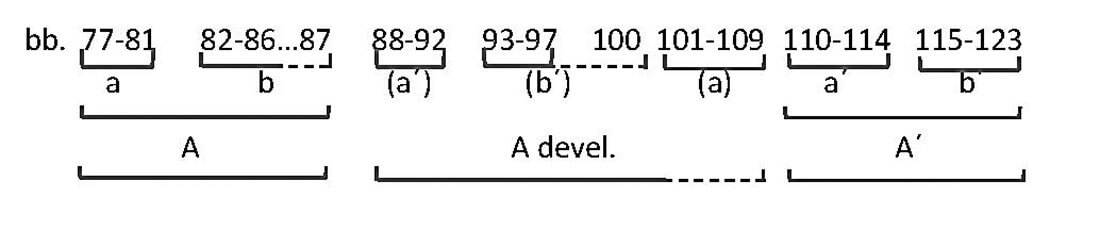
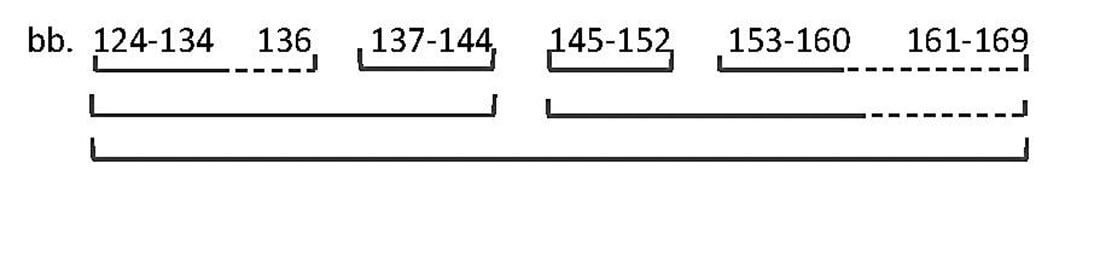
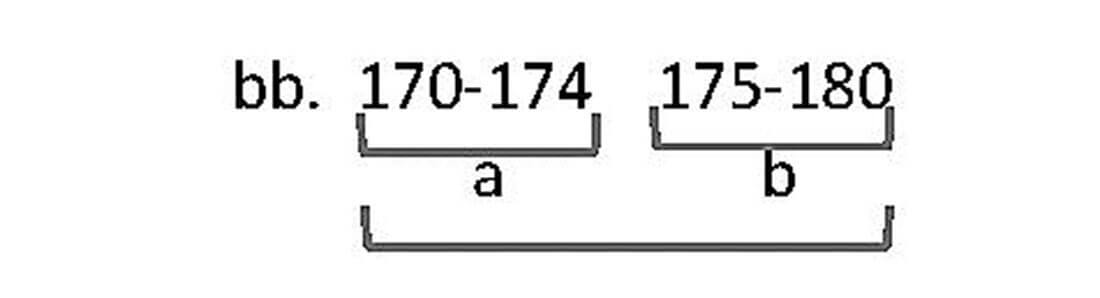
Formally, the Concerto for Piano, Violin, and Orchestra is organized as a concertino in one movement with five sections (Diagram 1), each with a different rhythmic structure and a different time signature. However, this clear division can be partly shadowed by a sonata-like formal plan with reversed recapitulation, having A (Allegro giusto) and B (Andante sostenuto) as the exposition, C (Allegro vivo) as development, and B΄ (Andante sostenuto) and Α΄ (Allegro) as reversed recapitulation.
Diagram 1. Formal plan of Skalkottas’s Concerto for Piano, Violin, and Orchestra.
Allegro giusto

Andante sostenuto
Allegro vivo
Andante sostenuto
Allegro
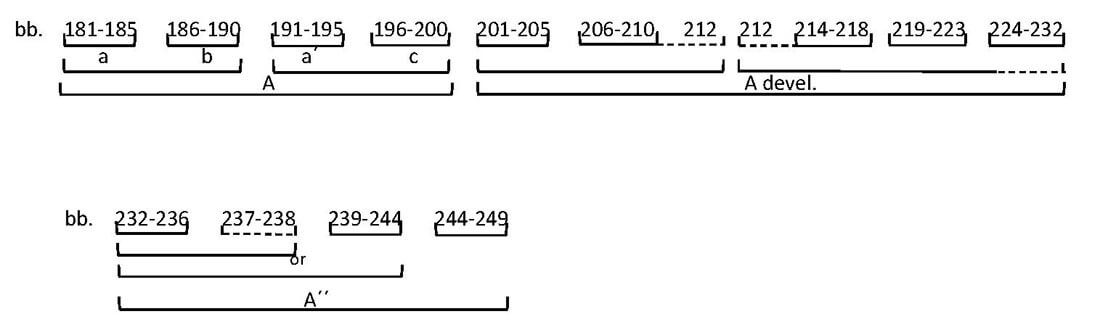
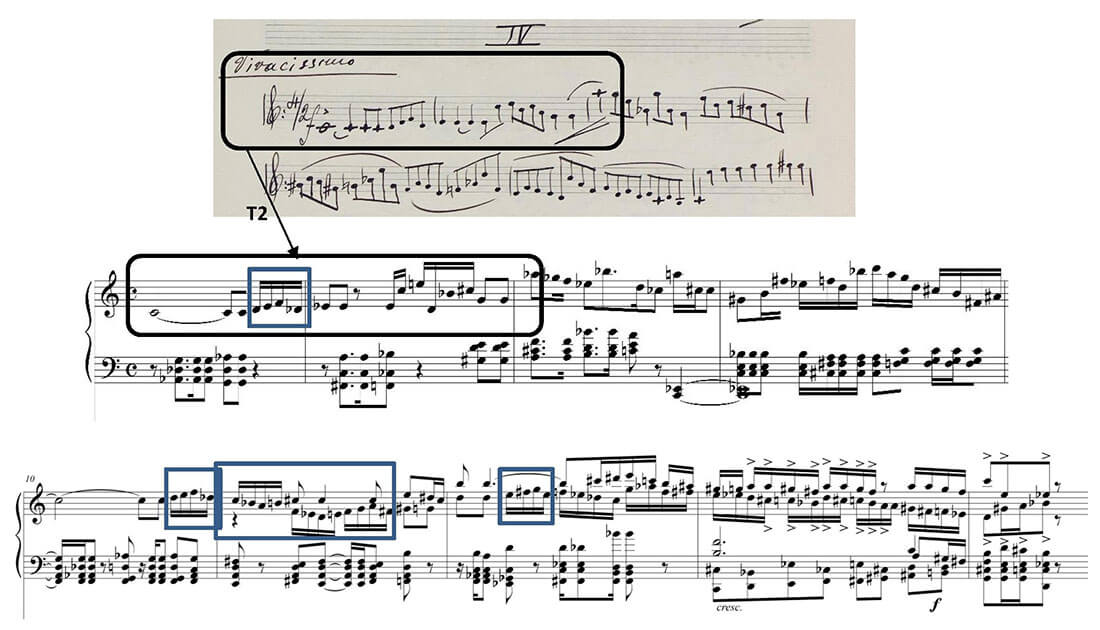
In the preceding formal plan, the deviations from common-practice prototypes, as well as from the formal organization of Skalkottas’s other concertos, are obvious: one needs only to note the division into five sections, the relevant length of each formal section, and the interrelations of several layers of the grouping structure in some cases. On the other hand, in terms of thematic and motivic development, as well as harmonic language, one can easily find evidence for the use of compositional techniques that were to become idiomatic of Skalkottas’s compositional practice thereafter. One of them is the incorporation of diatonic elements,[17] which may be associated with his interest in Greek folk music, but can also be attributed to the structural consequences of his music’s deeper harmonic structure. Yet, the way in which these diatonic elements manifest themselves varies among different works. In this particular concerto, they become apparent already at the opening four-bar phrase of the Allegro giusto, which is identical to a theme of Skalkottas’s tonal work Symphonietta in B@ (Example 1, upper and middle staff). At the same time, in both compositions, the first bar is reminiscent of the Greek folk song Ένα καράβι από τη Χιό (Α Boats from Chios).[18] However, the diatonic feel of this opening gesture is subsequently undermined, as it is further developed through contrapuntal techniques and is used liberally in the context of serial structures. Furthermore, other techniques of motivic manipulation, such as transpositional (or not) imitations, melodic inversion, retrograde, augmentation, and diminution, are also employed for the transformation of melodic fragments that derive from this opening gesture (Example 1, lower staff).
Example 1. Upper staff: Symphonietta in B@, movement iv, clarinet-in-B@ part, bb.1–6; Middle staff: Concerto for Piano, Violin, and Orchestra, bb.1–4; Lower staff: Concerto for Piano, Violin, and Orchestra, orchestral repetition of melodic fragments from the theme’s opening melodic gesture, bb. 10–14.
Within the constraints of this article, special attention is given only to section C of the Concerto for Piano, Violin, and Orchestra (Allegro vivo) as a characteristic example of the ways in which Skalkottas incorporates diatonic elements within an otherwise atonal environment, creating an interesting harmonic world in the middle formal section of the work. Furthermore, structural features of this particular section can also be found in the other sections of the work, both because they are foreshadowed in the preceding ones (Allegro giusto and Andante sostenuto), and because they penetrate the following ones (Andante sostenuto and Allegro) through processes of developing variation.
Manifestation of diatonic elements in the Allegro vivo
To begin with, tertian harmonic structures stand out of the otherwise atonal surface of the Allegro vivo, bars 145–60 presenting a typical and representative example. This passage includes both the solo instruments and the orchestra, with the surface pitch material divided between five to six textural layers. Among them, the violin has the most prominent role and the orchestra accompanies. It is in this accompaniment where the diatonic tertian chords stand out, starting as thirds in bars 145–46 and developing further into full second-inversion chords in bars 148–52 (Example 2; chords are indicated with letters). More specifically, these accompaniment fragments move chromatically around a G-minor chord within a chord progression that is both rhythmically and registrally articulated. Even the way in which this process begins in bars 145–46 is remarkable: at the upper layers of the orchestral accompaniment, the first minor thirds appear and move chromatically towards the initial chord of the following progression; at the lower layer of the orchestral accompaniment, D comes after a stepwise motion that starts from A@; at the same time, the left-hand octaves in the piano part lead to D in bar 146 through another stepwise motion that outlines a G-minor chord. Interestingly enough, after this six-bar passage of chromatically moving second-inversion chords (Example 2, bars 147–52), the chordal context gives way to a more linear texture (Example 2, bars 162–64) in almost the same way as the one in which it was prepared in bars 145–46. What is more, it seems that, in this passage, the aforementioned chord progression is organized around the referential center of G and this phenomenon may be interpreted as a manifestation of pitch centricity.[19]
In the same passage, other consonances emerge in the orchestral accompaniment, the first one being a broken C-minor chord that leads to a broken C#-minor chord in bars 151–52 and finally to D in bar 153 (Example 2). Although this C-minor chord is doubled by the piano in bars 148–50, it is combined with a C# in the left-hand part, a pitch included in the aforementioned chordal structure of bars 147–52. This combination undermines any potential tonal connotations of the chordal element and allows an octatonic subset to emerge. This is not the only instance of an octatonic structure in the work; in this specific passage, Skalkottas chooses to emphasize these octatonic gestures through articulation (staccato for the first two and accents with f dynamic in bar 151) and metric position.
Example 2. Concerto for Piano, Violin, and Orchestra, tertian elements in bars 145–55.
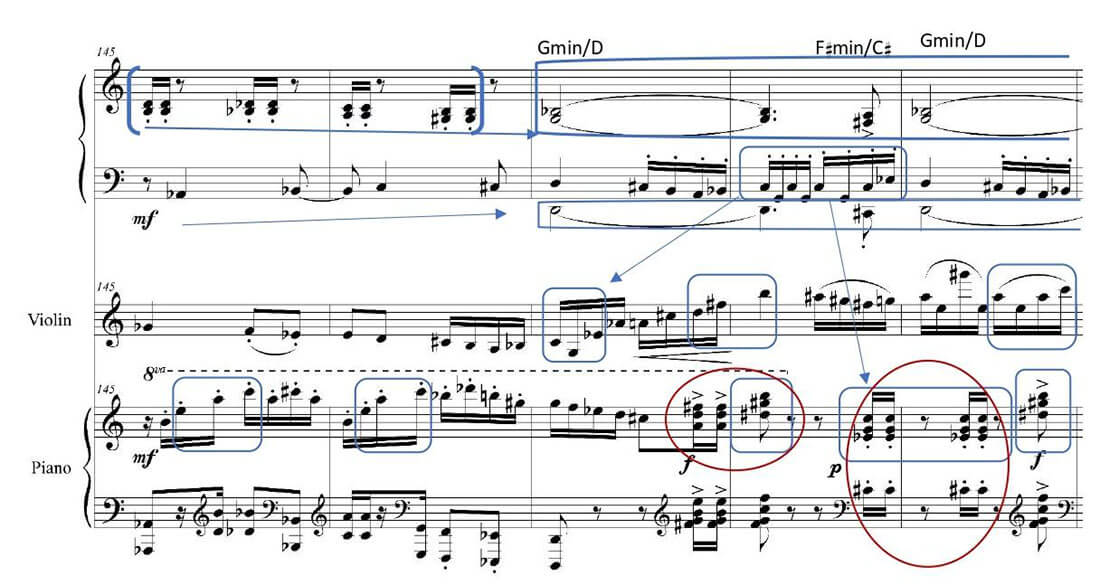
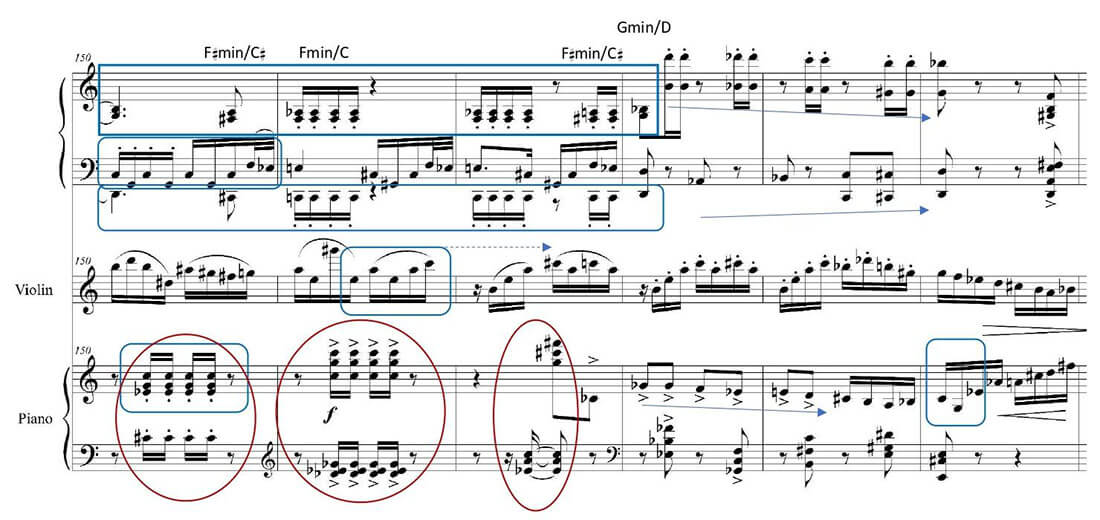
Other minor chords can be found in the violin part as melodic fragments. Although all of these diatonic-like elements have a prominent role on the musical surface, they are not tonally functional at all. It would be easier to establish functionality if root progressions existed on the musical surface or if the constituent chords didn’t move chromatically, or even if their combination did not allow octatonic implications to emerge. However, it is probably safe to assume that this was not the intention of the composer. After all, these chord progressions cannot even be heard as tonally functional, given the overall atonal environment and the fact that their diatonic implications are neutralized through their multi-layering on the musical surface, as well as through processes of motivic transformation. One of these processes pertains to the manipulation of the more or less diatonic motive D-E-F-D@ of the concerto’s opening gesture. This particular motive can be found all over the work and it has a prominent role in the Allegro vivo. Specifically, in this section, this motive appears inverted, with modified intervals (after successive transformation in previous bars) in bars 146, 148, and150 (violin), in bars 154, 156, and 158 (piano), and in bars 155 and 157 (violin) (Example 5).
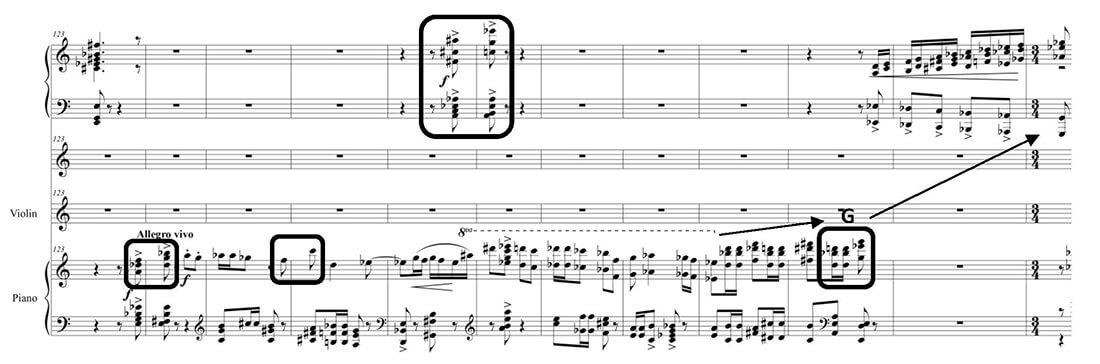
The Allegro vivo includes many more motivic references to tonal or diatonic music. The first one has to do with the ascending interval of a fourth, placed usually at the downbeat of the bar (Example 3). In fact, this motivic element, which resembles a cadential V-I gesture, is the basic and most characteristic motive of this particular section of the work, established as such from the very first presentation of its theme (bars 123–24). After that, even when the characteristic interval of a fourth changes, the rhythmic gesture reminds the initial motivic pattern, its motivic coherence being reinforced mostly through the use of accents and metric positioning. The following presentations of the motive show the following qualities: a) in bars 125–26, the rhythmic gesture is presented by the piano but within the context of the interval of a fifth; b) in bars 127–28, the orchestra brings the motive to the fore, even though it is written enharmonically; c) in bars 131–32, the final D-G comes as the culmination of a process in which the motive is consecutively repeated three times, each time broadening the interval of the ascending leap by one semitone (D-F, D-F#, and finally D-G), thus having as a result the projection of a linear succession of ascending semitones (F-F#-G). Thereby, the final G is given the quality of a melodic-harmonic goal, reached in an almost common-practice way.
Example 3. Concerto for Piano, Violin, and Orchestra, bars 123–34.
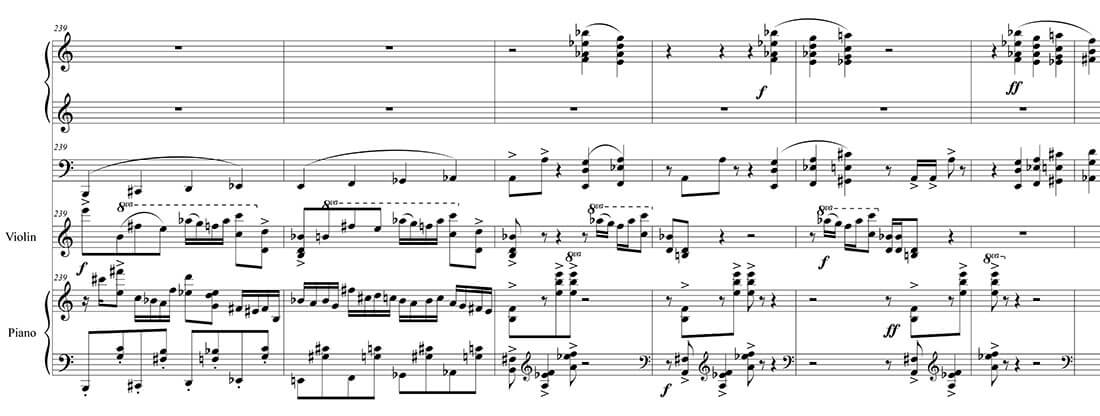
This same motive also reappears in subsequent sections of the work. For example, a passage of the final Allegro contains the same gesture, this time with modified intervallic content (Example 4) and emphasized through dynamic accents.
Example 4, Concerto for Piano, Violin, and Orchestra, bars 239–44.
Finally, another notable motivic element in the Allegro vivo pertains to the fact that even subsidiary melodic gestures, such as scale-like sequences, used to strengthen the sense of pitch centricity, are treated motivically. For example, the scalar pattern of bars 133–34 (Example 3) is repeated in bars 164–66 (Example 5) in order to serve the same purpose: to lead to G and G@ through two contrapuntally combined divergent paths (one ascending, one descending), thus confirming the G-minor centricity established in bars 147–53 by the use of chords and finally at the end of the section in bars 164–69 (Example. 6).
Pitch-class-set analysis of the Allegro vivo
At this point, we can claim that the multiplicity of textural layers and the resulting chromaticism make it difficult for the listener to perceive the music’s diatonic features as such. The reason for this is that they lack any contextual support and they blend with a continuous flow of atonal harmonies, resulting in a kind of harmonic ambiguity. Joseph N. Straus uses the word “neutralization”[20] in order to account for the way in which tonal or diatonic features tend to shed their tonal functionality when they participate in an otherwise atonal harmonic environment. Nevertheless, this is not the case for every atonal context, because there are several factors that affect the balance between two contrasting harmonic languages. For example, a triad as a subset of a hexachord presented vertically, a triad as an octatonic subset, or a triad in a linear configuration that is governed by serial procedures, are to be considered more neutralized than a triad as a subset of a tetrachord within an atonal two-layer passage.
Regarding the musical passage of the Allegro vivo with the G-minor chords (Example 2, bars 145–53), the acknowledgment of tertian elements on the musical surface encourages us to deduce a diatonic quality for its pitch organization; however, the continuous and simultaneous use of these elements in the context of a multilayered texture tends to neutralize any possible hierarchical relations within the passage’s harmonic environment, thus challenging the pertinence of this diatonic quality to the listener’s experience. Thus, all these surface events finally raise questions about the identity of the given context and the harmony of the passage.
Having demonstrated how certain pitch-centric events and diatonic elements emerge on the musical surface of the Allegro vivo, we will now try to analyze it in terms of the harmonic species and genera from which it derives, in order to clarify, in a systematic manner, how these tonal or diatonic elements contribute to its harmonic environment. To begin with, Example 5 demonstrates the segmentation of the musical surface of the Allegro vivo (bars 123–69). Τhe proposed segmentation takes into account issues of articulation, rhythmic structure, dynamics, and texture.
Example 5. Concerto for Piano, Violin, and Orchestra, segmentation of the Allegro vivo.
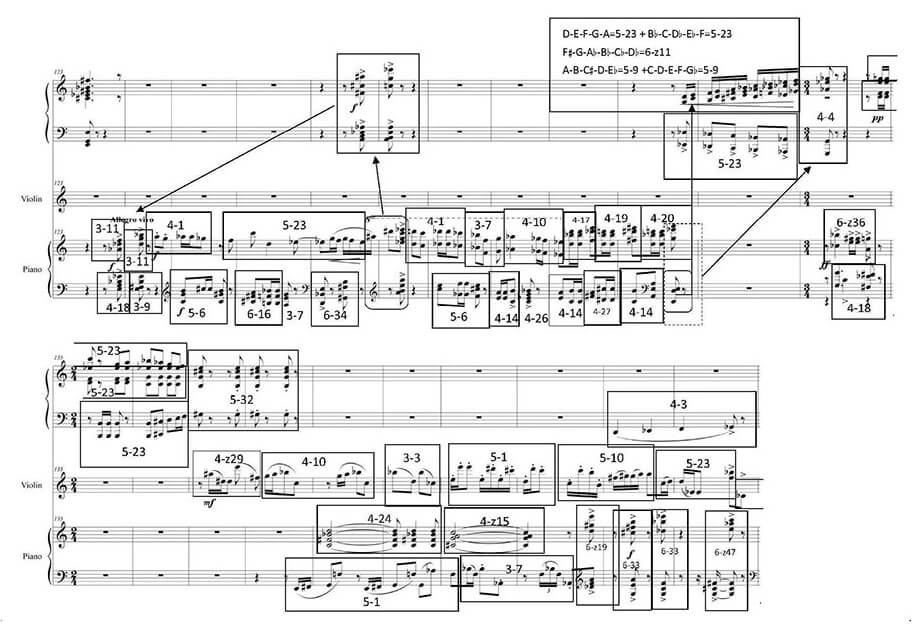
Example 5 continued.
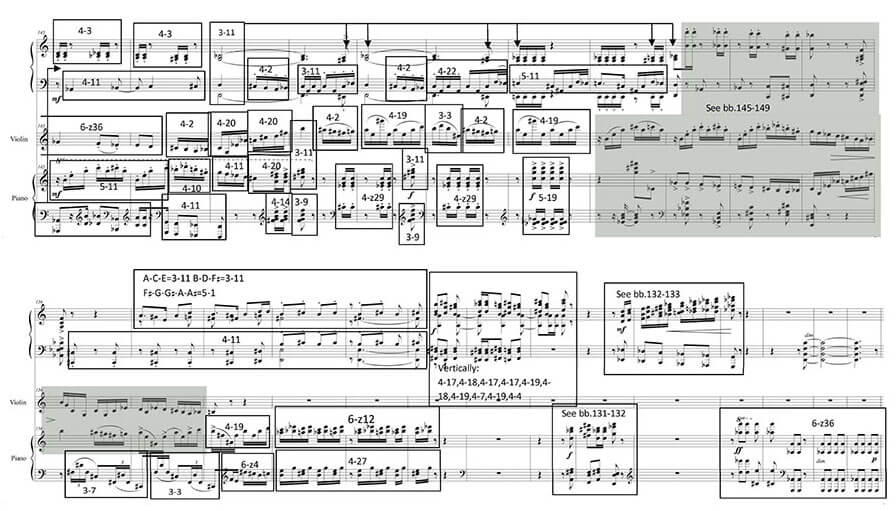
According to this segmentation, the pc-set vocabulary of the Allegro vivo section consists of four trichords, fifteen tetrachords, seven pentachords, and six hexachords. Out of these thirty-two pc sets, eighteen are found in bars 145–60 (the “G-minor passage” previously discussed) and specifically in bars 145–52, since the pc-set content of these bars is the same as the one in bars 152–60. We will begin the analysis of genera by first focusing on this particular passage, in order to corroborate the extent to which diatonic or tonal genera contribute to its harmonic species.
Generic structure of the “G-minor passage” of the Allegro vivo
Table 2 presents the complete generic matrix of bars 145–60, which demonstrates the distribution of the various pc sets of the passage over the different genera. The pc-set vocabulary of the passage seems to span over all twelve genera, with relatively similar number of representatives. Furthermore, this matrix includes many singletons (3-9, 4-3, 4-10, 4-11, 4-14, 4-17, 4-20), which will prompt the engagement of the corresponding genera in their entirety in the reduced matrix, according to the “rule of singleton extension”.[21] Out of these singletons, pc sets 4-10, 4-11, and 4-14 are subsets of the diatonic collection, yet they are usually found in post-tonal idioms.[22] Another significant component of the matrix is the “all-interval” tetrachord 4-z29, which is the only set in the matrix that belongs to genera G1 and G2, without any other connection. In fact, this tetrachord is usually found in the works of early 20th century and, in the case of the present analysis, will probably account for the engagement of one of these two corresponding genera.
Table 2. Concerto for Piano, Violin, and Orchestra, complete generic matrix of the “G-minor passage” in bars 145–60.
|
G1 |
G2 |
G3 |
G4 |
G5 |
G6 |
G7 |
G8 |
G9 |
G10 |
G11 |
G12 |
|
|
3-3 |
x |
x |
x |
|||||||||
|
3-7 |
x |
x |
x |
|||||||||
|
3-9 |
x |
|||||||||||
|
3-11 |
x |
x |
x |
|||||||||
|
4-2 |
x |
x |
||||||||||
|
4-3 |
x |
|||||||||||
|
4-10 |
x |
|||||||||||
|
4-11 |
x |
|||||||||||
|
4-14 |
x |
|||||||||||
|
4-17 |
x |
|||||||||||
|
4-19 |
x |
x |
x |
x |
||||||||
|
4-20 |
x |
|||||||||||
|
4-z29 |
x |
x |
||||||||||
|
5-1 |
x |
x |
||||||||||
|
5-11 |
x |
x |
x |
x |
x |
x |
x |
|||||
|
5-19 |
x |
x |
x |
x |
x |
|||||||
|
6-z3 |
x |
x |
x |
x |
x |
x |
x |
|||||
|
6-z4 |
x |
x |
x |
x |
x |
|||||||
|
4 |
4 |
2 |
1 |
5 |
7 |
5 |
5 |
6 |
5 |
3 |
3 |
The next step of the analysis is to calculate the S-Quos for every genus in this particular matrix, in order to ascertain the relative strength of each one of them. The S-Quo index, in order of descending relative strength, is as follows:
0,095: G5 (chroma)
0,086: G6 (semichroma)
0,081: G9 (atonal-tonal)
0,067: G10 (atonal-tonal) & G8 (atonal)
0,061: G7 (chroma-dia)
0,057: G11 (dia)
0,037: G12 (dia-tonal)
0,035: G1 (atonal)
0,034: G2 (whole-tone)
0,027: G4 (augmented)
0,025: G3 (diminished)
What is interesting about this S-Quo index is that the S-Quos of the first seven genera are very close numerically. However, in terms of supragenera,[23] the index distribution seems to lean heavily towards the predominance of Supragenus II (chromatic), with its constituents (G5 and G6) having the highest S-Quos. The atonal Supragenus III, with G9, G10, and G8, seems to have a secondary role, followed by the diatonic Supragenus IV (G11 and G12). The S-Quos of the genera of the atonal-hybrid Supragenus I are notably low. Additionally, it is worth noting that two genera (G10 and G8) have the same S-Quo. The kind of S-Quo relations described above will probably lead to the engagement of a large number of genera in the final reduced matrix of generic relations that defines the specific harmonic species of this particular passage.
The next step of the analysis is to assign each pc set to only one genus according to the rules for the interpretation of generic relations.[24] Genus 5 (chroma) will retain all the pc sets of the first matrix according to Rule 1 (“rule of the greatest status quotient”).[25] Additionally, the application of Rule 2 (“rule of intersection”)[26] will result in the omission of Genus 4 (augmented) from the reduced matrix, because it is a proper subset of Genus 8 (atonal), which has a greater S-Quo. Accordingly, Genus 3 (diminished) is omitted as a proper subset of Genus 1. The reduced matrix of generic relations (Table 3) demonstrates how the application of all five rules reduces the number of relevant genera to seven: G1, G5, G6, G7, G9, G10, and G11.
Table 3. Concerto for Piano, Violin, and Orchestra, reduced matrix of generic relations of the “G-minor passage” in bars 145–60.
|
G1 |
G5 |
G6 |
G7 |
G9 |
G10 |
G11 |
|
|
3-3 |
x |
||||||
|
3-7 |
x |
||||||
|
3-9 |
x |
||||||
|
3-11 |
x |
||||||
|
4-2 |
x |
||||||
|
4-3 |
x |
||||||
|
4-10 |
x |
||||||
|
4-11 |
x |
||||||
|
4-14 |
x |
||||||
|
4-17 |
x |
||||||
|
4-19 |
x |
||||||
|
4-20 |
x |
||||||
|
4-z29 |
x |
||||||
|
5-1 |
x |
||||||
|
5-11 |
x |
||||||
|
5-19 |
x |
||||||
|
6-z3 |
x |
||||||
|
6-z4 |
x |
||||||
|
1 |
5 |
2 |
3 |
4 |
2 |
1 |
The reduced generic matrix proves that the outstanding feature of this passage’s harmonic species is provided by Genus 5 (chroma), the progenitors of which are trichords 3-1 and 3-2. However, a kind of generic diversity is brought about by other genera of the reduced matrix. In fact, the particular generic structure of this passage is quite unusual because it is based on a large number of genera and the number of G5 representatives is not very far from G9’s (atonal-tonal) entries. However, Genera G1, G6, G10, and G11 have a sparse representation in the matrix. In terms of supragenera, it is noteworthy that the genera included in this matrix introduce almost every supragenus, making the final conclusion about harmonic structure even more ambivalent.
According to the preceding analysis, the “pitch-centric event” of bars 145–60 is understood to belong to a harmonic environment that may be characterized as chromatic-atonal, a feature which is largely achieved through the multilayering of the musical texture. However, the result of this analysis is, in fact, rather questionable, not only because it pertains to the generic structure of a small passage, but mainly because the numbers of genera representatives do not give a clear generic structure with straightforward predominance. After these remarks, and considering that the majority of the pc sets in bars 145–60 are also found in the previous bars, it seems worthwhile to examine the characteristics of the harmonic species of the Allegro vivo as a whole, in order to understand the actual context in which the “G-minor passage” occurs.
Generic structure of the entire Allegro vivo
Table 4 offers an overview of the generic relations for the entire Allegro vivo, the pc-set vocabulary of which consists of the same four trichords as the ones in the previous passage, fifteen tetrachords, seven pentachords, and six hexachords. At first sight, the distribution of pc sets in the complete matrix probably shows generic diversity. The matrix includes the same singletons as the previous passage (bars 145–60), which will prompt the engagement of the corresponding genera in the final reduced matrix.
Table 4. Concerto for Piano, Violin, and Orchestra, complete generic matrix of the Allegro vivo.
|
G1 |
G2 |
G3 |
G4 |
G5 |
G6 |
G7 |
G8 |
G9 |
G10 |
G11 |
G12 |
|
|
3-3 |
x |
x |
x |
|||||||||
|
3-7 |
x |
x |
x |
|||||||||
|
3-9 |
x |
|||||||||||
|
3-11 |
x |
x |
||||||||||
|
4-1 |
x |
|||||||||||
|
4-2 |
x |
x |
||||||||||
|
4-3 |
x |
|||||||||||
|
4-10 |
x |
|||||||||||
|
4-11 |
x |
|||||||||||
|
4-14 |
x |
|||||||||||
|
4-z15 |
x |
x |
||||||||||
|
4-17 |
x |
|||||||||||
|
4-18 |
x |
x |
x |
|||||||||
|
4-19 |
x |
x |
x |
x |
||||||||
|
4-20 |
x |
|||||||||||
|
4-24 |
x |
x |
||||||||||
|
4-26 |
x |
|||||||||||
|
4-27 |
x |
x |
||||||||||
|
4-z29 |
x |
x |
||||||||||
|
5-1 |
x |
x |
||||||||||
|
5-6 |
x |
x |
x |
|||||||||
|
5-9 |
x |
x |
x |
x |
x |
|||||||
|
5-10 |
x |
x |
x |
x |
x |
|||||||
|
5-19 |
x |
x |
x |
x |
x |
|||||||
|
5-23 |
x |
x |
x |
|||||||||
|
5-32 |
x |
x |
x |
x |
||||||||
|
6-z3 |
x |
x |
x |
x |
x |
x |
x |
|||||
|
6-z4 |
x |
x |
x |
x |
x |
|||||||
|
6-z11 |
x |
x |
x |
x |
x |
x |
x |
x |
x |
x |
x |
|
|
6-z25 |
x |
x |
x |
x |
x |
x |
x |
|||||
|
6-33 |
x |
x |
x |
x |
x |
|||||||
|
6-34 |
x |
x |
x |
x |
x |
x |
x |
x |
x |
x |
x |
|
|
32 |
14 |
15 |
8 |
3 |
7 |
10 |
12 |
7 |
9 |
9 |
6 |
9 |
The S-Quo index, in order of descending relative strength, is as follows:
0,083: G7 (chroma-dia)
0,075: G5 (chroma)
0,073: G2 (whole-tone)
0,069: G1 (atonal) & G6 (semichroma)
0,068: G9 (atonal-tonal) & G10 (atonal-tonal)
0,064: G11 (dia)
0,062: G12 (dia-tonal)
0,058: G3 (diminished)
0,053: G8 (atonal)
0,046: G4 (augmented)
This index includes two pairs of genera with the same S-Quo: G1-G6 and G9-G10. In the second case (G9-G10), this has partly to do with the size of these genera (see Table 1, column “Counts”), but we need to remember that this pair has also low Difquo, which means that they are not extensively different. On the contrary, G1 and G6 are not at all similar and also belong to different supragenera. However, the count of members in Genus 1, which has 14 representatives in the initial matrix, places it fourth in the list and, regarding the fact that (except for 4-18) all the sets of G1 belong also to G2, which has a greater S-Quo, Genus 1 will probably be excluded from the final reduced matrix, according to the rule of intersection. Applying the five rules for the interpretation of generic relations, the reduced generic matrix is formed as shown in Table 5.
Table 5. Concerto for Piano, Violin, and Orchestra, reduced matrix of generic relations in the Allegro vivo.
|
G2 |
G5 |
G6 |
G7 |
G9 |
G10 |
G11 |
G12 |
|
|
3-3 |
x |
|||||||
|
3-7 |
x |
|||||||
|
3-9 |
x |
|||||||
|
3-11 |
x |
|||||||
|
4-1 |
x |
|||||||
|
4-2 |
x |
|||||||
|
4-3 |
x |
|||||||
|
4-10 |
x |
|||||||
|
4-11 |
x |
|||||||
|
4-14 |
x |
|||||||
|
4-z15 |
x |
|||||||
|
4-17 |
x |
|||||||
|
4-18 |
x |
|||||||
|
4-19 |
x |
|||||||
|
4-20 |
x |
|||||||
|
4-24 |
x |
|||||||
|
4-26 |
x |
|||||||
|
4-27 |
x |
|||||||
|
4-z29 |
x |
|||||||
|
5-1 |
x |
|||||||
|
5-6 |
x |
|||||||
|
5-9 |
x |
|||||||
|
5-10 |
x |
|||||||
|
5-19 |
x |
|||||||
|
5-23 |
x |
|||||||
|
5-32 |
x |
|||||||
|
6-z3 |
x |
|||||||
|
6-z4 |
x |
|||||||
|
6-z11 |
x |
|||||||
|
6-z25 |
x |
|||||||
|
6-33 |
x |
|||||||
|
6-34 |
x |
|||||||
|
32 |
6 |
4 |
2 |
12 |
4 |
2 |
1 |
1 |
The generic structure of the entire Allegro vivo differs from the one of the previously examined “G-minor passage,” not only because it includes more sets, but also regarding the components of the harmonic species of the Allegro vivo as a whole. Here, Genus 7 (chroma-dia) is the predominant feature given that it has 12 entries in the reduced matrix. Interestingly enough, this particular genus seemed to have only a secondary role in the matrix of the “G-minor passage,” where it was engaged with two singletons (4-10 and 4-11) and the trichord 3-7. However, when it comes to the harmonic structure of the entire Allegro vivo, it appears to be the most prominent genus. Another differentiation has to do with genera G1 and G2, the pair of genera with the lowest Difquo, which belong to the same Supragenus I. In the case of bars 145–60, G1 entered the final matrix with the tetrachord 4-z29, which can be found only in G1 and G2. Meanwhile, only three more sets of the total of eighteen sets could be found in these two genera (Table 2) and, according to the rules for the interpretation of generic relations, they were assigned to other genera in the final reduced matrix (Table 3). However, in the case of the Allegro vivo section in its entirety, it is Genus 2, with a relatively high S-Quo, that receives 6 entries (Table 5) without any of them being a singleton. On the contrary, G1, which had 14 representatives in the initial distribution, does not even enter the final matrix.
It is also interesting to point out the role of Genus 5 (chroma), which had the principal role in the generic identity of the passage of bars 145–60. In the entire Allegro vivo, G5 has the next highest S-Quo after G7 (chroma-dia), but in the final matrix it gets only three entries. The feature that both matrices have in common is the consistent role of genera G6, G9, G10, and G11, which maintain the same number of pc sets assigned.
Finally, it becomes obvious that the harmonic species of the Allegro vivo combines very different components in a compact way. Someone would expect that diatonic genera, such as G11 (dia) and G12 (dia-tonal), would have a greater number of representatives, considering the diatonic-like pitch-class structures and the pitch-centric chordal events on the musical surface of passages like the one in bars 145–60. However, Genus 11 is included in the final matrix because of the singleton 3-9 and Genus 12 because of another singleton, the tetrachord 4-26. It eventually becomes obvious that every pitch-class formation that might be considered part of the traditional vocabulary of diatonic or tonal music, on the musical surface of this specific section as a whole, may be thought to serve as an element of divergence from an otherwise coherently atonal musical surface. Finally, as can be seen in the final reduced matrix, Genus 7 (chroma-dia) plays an important role in the harmonic species of the section, but it is combined with other components, many of which are very different from it in terms of Difquo. Comparing all genera included in the reduced matrix, pairs of largely different genera (high Difquo values) are quite frequent (e.g., G5-G11, G5-G12, G6-G11, G5-G10, G2-G5, G2-G11). More interesting, though, is the relation of the atonal-tonal genera G9 and G10 with G7. From a comparative perspective, it becomes obvious that the genus with the greatest significance in the matrix (G7) is combined with genera that are very different to it. For instance, the Difquo of generic pairs G7-G9 and G7-G10 is 0.6564102, whereas the Difquo of G7-G6 and G7-G12 is 0.3145927. This is the feature that makes the harmonic species of this particular section unique and also objectively accounts for the perceived diversity that characterizes the pc-set content of the passage on its musical surface.
Conclusions
The preceding analysis of Skalkottas’s Concerto for Piano, Violin, and Orchestra has tried to substantiate the possibility of the composer’s intention to play with the expectations of his listeners, inasmuch as he seems to employ familiar pc-set configurations on the musical surface with obvious diatonic implications, yet within a context that is characterized by a lack of tonal hierarchy and a multiplicity of textural layers. In this respect, diatonic features on the musical surface eventually become just elements of the overall atonal structure, in which all transformations applied to the thematic and motivic content of the work are largely governed by processes of developing variation. In other words, Skalkottas seems to organize the pitch content of his work within an overall atonal context, which is, nonetheless, informed by methods of developing and varying familiar musical material from the tonal tradition. In this respect, the diatonic gestures that adorn the musical surface of his atonal works pertain more to his compositional technique and less to the aesthetic outlook that he intends to convey to his listeners. The use of diatonic or tonal elements on the surface of an atonal work may be the composer’s conscious or subconscious decision, yet that does not mean that they are necessarily understood as such by the listeners, given that their inter-relations are not determined by common-practice procedures of harmonic functionality and tonal voice-leading.
The generic organization of the central section of the Concerto for Piano, Violin, and Orchestra gives a broad picture of its harmonic species, in which chromaticism and diatonic elements play a central role. The predominant genus appears to be G7 (chroma-dia), with progenitors the pc sets 3-2 and 3-7; this genus combines chromatic pc sets with subsets of either diatonic or octatonic collections. At the same time, the analysis of the “G-minor passage” (bars 145–60), which aimed at ascertaining the extent to which diatonic or tonal genera contribute to the harmonic species of this particular passage, at first seems to undermine the structural pertinence of surface diatonic elements to the otherwise chromatic harmonic environment of the passage. However, reconsidering the structure of this passage in the context of the Allegro vivo in its entirety confirms that generic diversity and chromaticism seem to be the overriding factors of this section’s overall harmonic organization. Thus, it becomes obvious that the diatonic character of the Allegro vivo is not based on clearly perceptible diatonic events on the musical surface, but through the mere use of certain diatonic gestures that emerge as a consequence of the development of the musical material, motives, and thematic structures.
Works Cited
Ayrey, Craig. “Berg’s ‘Warm die Lüfte’ and PC Set Genera: A Preliminary Reading.” Music Analysis 17 (1998): 163–76.
Doerksen, John F. “Set-Class Salience and Forte’s Theory of Genera.” Music Analysis 17 (1998): 195–205.
Forte, Allen. “Debussy and the Octatonic.” Music Analysis 10 (1991): 125–69.
Forte, Allen. “Pitch-Class Set Genera and the Origin of Modern Harmonic Species.” Journal of Music Theory 32, no. 2 (1988): 187–270.
Forte, Allen. “The Diatonic Looking-Glass, or an Ivesian Metamorphosis.” The Musical Quarterly 76 (1992): 355–82.
Forte, Allen. The Structure of Atonal Music. New Haven and London: Yale University Press, 1973.
Gates, Bernard. “A Pitch-Class Set Space Odyssey, Told by Way of a Hexachord-Induced System of Genera.” Music Analysis 32, no. 1 (2013): 80–153.
Kleppinger, Stanley. “Reconsidering Pitch Centricity.” Theory and Practice 36 (2011): 65–109.
Matzourani, Eva. The Life and Twelve-Note Music of Nikos Skalkottas. Farnham: Ashgate, 2011.
Papagiannopoulou, Penelope. “Οργάνωση φθογγικού υλικού και μορφής στα διπλά κοντσέρτα του Νίκου Σκαλκώτα: Παράδοση και πρωτοτυπία” [Pitch-Class Organization and Form of Nikos Skalkottas’s Double Concertos: Classical Tradition and Innovation]. PhD diss., Aristotle University of Thessaloniki, 2019.
Papaioannou, John G. ΝίκοςΣκαλκώτας 1904-1949: Μίαπροσπάθειαείσδυσηςστονμαγικόκόσμοτηςδημιουργίαςτου [Nikos Skalkottas 1904-1949: An Endeavour to Enter into the Magical World of his Creativity]. 2 vols. Athens: C. Papagrigoriou - H. Nakas Co, 1997.
Parks, Richard. “Pitch-Class Set Genera: My Theory, Forte’s Theory.” Music Analysis 17 (1998): 206–26.
Pye, Richard C. “The Construction and Interpretation of Bespoke Pitch-Class Set Genera as Models of Harmonic Duality in William Schuman's Sixth Symphony.” Music Theory Spectrum 25, no. 2 (2003): 243–74.
Salles, Paulo de Tarso. “Voice Leading Among Pitch-Class Sets: Revisiting Allen Forte’s Genera.” MusMat 4, no. 2 (2020): 66–79.
Straus, Joseph N. Remaking the Past: Musical Modernism and the Influence of the Tonal Tradition. Cambridge, MA, & London: Harvard University Press, 1990.
Zervos, Yorgos. “Musical Idioms and Aesthetic Directions in Skalkottas’ Work.” In Nikos Skalkottas: A Greek European, edited by Harris Vrondos, 50–85. Athens: Benaki Museum, 2008.
[1] Concerto for Piano, Violin, and Orchestra (1930), Concertino for Two Pianos (1935), Concerto for Violin, Viola, and Wind Orchestra (1939–1940), and Concerto for Two Violins and Orchestra (1944). Concertos which may have been composed earlier than 1930 are considered lost.
[2] This performance took place at Singakademie and the soloists were the violinist Anatol Knorre and the Greek pianist Polyxene Mathey. The concert was sponsored by the Greek Embassy in Berlin and also included the first performance of the Little Suite for Orchestra (1930). However, this performance was thought for years to have been the only one, because the manuscripts of those two works were considered lost. The concerto was performed again after almost ninety years (13 February 2018) at the Athens Concert Hall, with the Athens Philharmonia Orchestra, Georgios Demertzis at the violin, and Vassilis Varvaressos at the piano.
[3] Eva Matzourani, The Life and Twelve-Note Music of Nikos Skalkottas (Farnham: Ashgate, 2011), 34, 36, 381; John G. Papaioannou, Νίκος Σκαλκώτας 1904–1949: Μία προσπάθεια είσδυσης στον μαγικό κόσμο της δημιουργίας του [Nikos Skalkottas 1904–1949: An Endeavour to Enter into the Magical World of his Creativity] (Athens: C. Papagrigoriou – H. Nakas Co, 1997), 1:182, 235, 345.
[4] Yannis Samprovalakis, liner notes for Nikos Skalkottas, Sinfonietta, Concerto for Violin, Piano, and Orchestra, Suite for Violin and Chamber Orchestra, Athens Philharmonia Orchestra, Byron Fidetzis, conductor, Georgios Demertzis, violin, and Vassilis Varvaressos, piano, BIS2434, 2019, CD, 13–14. Yannis Samprovalakis was also the one who completed the orchestration of the work,
[5] Penelope Papagiannopoulou, “Οργάνωση φθογγικού υλικού και μορφής στα διπλά κοντσέρτα του Νίκου Σκαλκώτα: Παράδοση και πρωτοτυπία” [Pitch-Class Organization and Form of Nikos Skalkottas’s Double Concertos: Classical Tradition and Innovation] (PhD diss., Aristotle University of Thessaloniki, 2019), 35–76.
[6] Allen Forte, The Structure of Atonal Music (New Haven and London: Yale University Press, 1977).
[7] Allen Forte, “Pitch-Class Set Genera and the Origin of Modern Harmonic Species,” Journal of Music Theory 32, no. 2 (1988): 187–270.
[8] Since the emergence of Forte’s theory of genera, there have been many attempts to propose alternative genera-based models, e.g. Allen Forte, “Debussy and the Octatonic,” Music Analysis 10 (1991): 125–69; Allen Forte, “The Diatonic Looking-Glass, or an Ivesian Metamorphosis,” The Musical Quarterly 76 (1992): 355–82; Craig Ayrey, “Berg’s ‘Warm die Lüfte’ and PC Set Genera: A Preliminary Reading,” Music Analysis 17 (1998): 163–76; John F. Doerksen, “Set-Class Salience and Forte’s Theory of Genera,” Music Analysis 17 (1998): 195–205; Richard Parks, “Pitch-Class Set Genera: My Theory, Forte’s Theory,” Music Analysis 17 (1998): 206–26; Richard C. Pye, “The Construction and Interpretation of Bespoke Pitch-Class Set Genera as Models of Harmonic Duality in William Schuman's Sixth Symphony,” Music Theory Spectrum 25, no. 2 (2003): 243–74; Bernard Gates, “A Pitch-Class Set Space Odyssey, Told by Way of a Hexachord-Induced System of Genera” Music Analysis 32, no. 1 (2013): 80–153; Paulo de Tarso Salles, “Voice Leading Among Pitch-Class Sets: Revisiting Allen Forte’s Genera,” MusMat 4, no. 2 (2020): 66–79. In the present paper, it has been deemed appropriate to use Forte’s original theoretical model, described in his aforementioned 1988 article.
[9] Forte, “Pitch-Class Set Genera,” 190–92.
[10] Forte, “Pitch-Class Set Genera,” 222.
[11] For example, see Forte’s complete matrix for Schoenberg’s op. 11, no. 1 in Forte, “Pitch-Class Set Genera,” 238–39.
[12] Forte, “Pitch-Class Set Genera,” 264–66.
[13] Forte, “Pitch-Class Set Genera,” 232.
[14] Rule 1: “The Rule of greatest status quotient determines the genus with primary role;” Rule 2: “The Rule of intersection omits genera which are proper subsets of other genera with higher Squos;” Rule 3: “The Rule of Completion completes the generic matrix in case the genus with the highest ‘operational’ Squo does not account for every set, by invoking the genus with the next highest Squo to provide a setting for the vagrant pitch-class set(s);” Rule 4: “The Rule of singleton extension causes pitch-class sets which are attached to only one genus (‘singletons’) to engage that genus in its entirety;” and Rule 5: “The Rule of Reduction omits genera, ‘passive genera,’ which do not contribute to the generic profile of the composition, as determined by Rules 1, 3, and 4.” Forte, “Pitch-Class Set Genera,” 234.
[15] Forte, “Pitch-Class Set Genera,” 235.
[16] Yorgos Zervos, “Musical Idioms and Aesthetic Directions in Skalkottas’ Work’, in Nikos Skalkottas: A Greek European, ed. Harris Vrondos (Athens: Benaki Museum, 2008), 50–85.
[17] In the present article, the term “diatonic elements” is used in order to designate any kind of reference to diatonic music. In fact, as one can realize in the analysis, the work at hand incorporates more than subsets of the diatonic collection. For example, one of the frequently used pc sets in the analysis is the tetrachord 4-10 (according to Forte’s nomenclature). This tetrachord is indeed a subset of the diatonic collection, but it is also contained in the octatonic collection. Skalkottas often creates points of intersection between these two collections. Furthermore, the term often involves other contextual means of reference to diatonic harmony that will become more apparent in the following pages.
[18] It is interesting to note that the Concerto for Piano, Violin, and Orchestra was composed during the Berlin years (1930), while the Symphoniettain B@ belongs to the last compositional period of Skalkottas (Athens, 1948). The almost twenty years that separate the two works may well be a proof of the existence of a common external point of reference.
[19] In the present article, the term “pitch centricity” is used in the way in which Joseph N. Straus describes it in his Introduction to Post-Tonal Theory, 2nd ed. (Upper Saddle River, New Jersey: Prentice Hall, 2000), 114: “notes that are stated frequently, sustained at length, placed in registral extreme, played loudly, and rhythmically or metrically stressed tend to have priority over notes that don’t have those attributes.” See also Stanley Kleppinger, “Reconsidering Pitch Centricity,” Theory and Practice 36 (2011): 65–109.
[20] Joseph N. Straus, Remaking the Past: Musical Modernism and the Influence of the Tonal Tradition (Cambridge, MA, & London: Harvard University Press, 1990), 17.
[21] Forte, “Pitch-Class Set Genera,” 234.
[22] These sets “have found their historical destinies not in traditional tonal music, but in essentially non-tonal musics of other kinds, including, for example, the atonal music of Schoenberg and Berg, and the octatonic-diatonic music of Stravinsky.” Forte, “Pitch-Class Set Genera,” 213.
[23] Forte, “Pitch-Class Set Genera,” 224–29.
[24] Forte’s rules for the interpretation of generic relations are described in detail in footnote 14.
[25] Forte, “Pitch-Class Set Genera,” 234.
[26] Forte, “Pitch-Class Set Genera,” 234.